
Reviewed · DAY TRIPS IN TASHKENT
Bukhara One Day Tour – Departure From Tashkent
Bukhara rewards an early start. This private day tour lets you travel from Tashkent by high-speed Afrosiyob train, see the old city with a guide, enjoy lunch, and return by air the same night. I like the efficient combination of train and flight, and I like that entrance fees, local transport, and lunch are included.
The private format gives you more control than a large group outing, and the guide can explain the mosques, madrassas, and mausoleums as you move through the city. The main drawback is the long day: with a 6:30 am transfer, a 7:30 am train, a full sightseeing schedule, and a flight back around midnight, you will be tired.
In This Review
- Five things to know before booking
- Why this Tashkent to Bukhara plan works
- Lyabi Khauz: Bukhara’s social heart
- Magoki Attori Mosque and the carpet museum
- Chor Minor and the blue-domed towers
- Trading Domes: a short window for shopping
- Po-i-Kalyan: the visual high point
- Ulugbek and Abdulaziz-Khan: two madrassas, two periods
- The Ark Fortress and Bolo Haouz Mosque
- The Samanid Mausoleum and Chashma Ayub
- What $249 includes, and where the value lies
- The guide can shape the whole day
- Who should book this Bukhara day trip?
- Final call: efficient, impressive, and tiring
- FAQ
- What time does the Bukhara day tour begin?
- How long does the train take from Tashkent to Bukhara?
- How do I return to Tashkent?
- Is lunch included?
- Are entrance fees included?
- Is this a private tour?
- What happens if the high-speed train is unavailable?
Five things to know before booking
- The Afrosiyob train saves valuable time: You leave Tashkent at 7:30 am and reach Bukhara at about 11:17 am.
- The tour covers Bukhara’s major sights: The route includes Lyabi Khauz, the Trading Domes, Po-i-Kalyan, the Ark, and several important mausoleums.
- You return by plane: A flight from Bukhara to Tashkent avoids repeating the four-hour train ride.
- The tour is private: Only your group takes part, so the pace can be adjusted within the tight schedule.
- Lunch and entrance fees are included: The $249 price covers the main costs of a complicated one-day trip.
- The schedule is demanding: You need moderate physical fitness and enough energy for a very early start and late finish.
Why this Tashkent to Bukhara plan works
Bukhara is far enough from Tashkent that transport can make or break a short visit. The high-speed Afrosiyob train handles the outward journey in roughly four hours, while the return flight keeps you from spending another full evening on the rails.
You transfer to Tashkent Railway Station at 6:30 am for the 7:30 departure. The train arrives in Bukhara at 11:17, where a guide and driver meet you before taking you toward the Old City. If the high-speed train is unavailable, the operator says it will use the most comfortable class of regular train instead.
That transport pairing is the clever part of the tour. You see the changing scenery from the train in the morning, then fly back after sightseeing. Still, the timetable leaves little spare time. A delay, a slow lunch, or extra time at one site can make the afternoon feel rushed.
The return transfer takes you to Bukhara Airport after the tour. You then fly to Tashkent and receive a transfer from the airport to your hotel or home. The advertised arrival is around midnight, so do not treat this as a relaxed day trip.
More Day Trips in Tashkent
- Samarkand One Day Tour – Departure From Tashkent
★ 5.0 · 313 reviews - All in One Day Tour of Samarkand from Tashkent
★ 5.0 · 34 reviews - From Tashkent: Chimgan Valley Hiking Day Trip
★ 4.9 · 24 reviews
Lyabi Khauz: Bukhara’s social heart
Your first stop is the Lyabi Khauz ensemble, scheduled for about an hour. Its center is a reservoir, or hauz, surrounded by major buildings including Kukeldash Madrasa, the Khanaka, and the Nodir Divan Begi complex.
This is a useful starting point because it gives you a sense of how old Bukhara was organized around water, religious schools, lodging buildings, and trade. The square also offers one of the clearest introductions to the city’s architectural style before you move into the denser monuments.
I would use this hour to listen carefully to the guide and get your bearings. The ensemble is not just a collection of attractive facades. It shows how public life, study, worship, and commerce once met around a shared water source.
Magoki Attori Mosque and the carpet museum
The next visit lasts about 30 minutes. Magoki Attori Mosque is an urban mosque set within a residential part of central Bukhara, which gives it a different feel from the grander congregational buildings later in the route.
A carpet museum is included at this stop. That adds a useful cultural layer to the day, especially if you want to understand more about regional craft traditions alongside the stone and brick architecture.
Thirty minutes is enough for a focused visit, but not for a slow museum study. If carpets are a major interest, you may need to keep your questions precise and watch the clock.
Chor Minor and the blue-domed towers
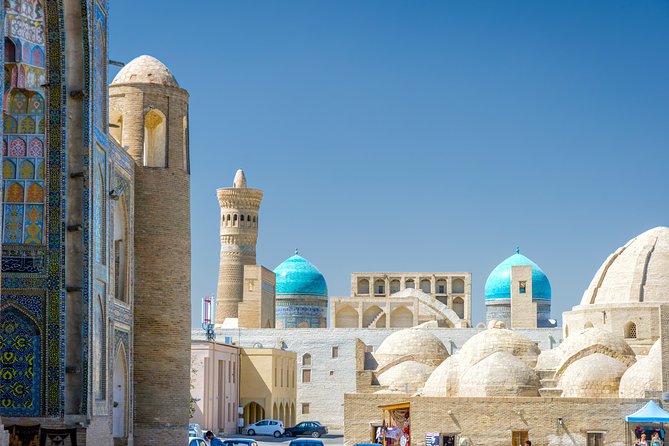
Chor Minor means four minarets, and the name explains the building’s most memorable feature. Each corner of the square-rectangular madrasa structure carries a small minaret topped by a blue dome, with decoration that differs from the others.
The stop is scheduled for 30 minutes and is located behind Lyabi Khauz. Chor Minor is a welcome change after the larger ensemble because its shape is compact and unusual. It also gives you a good visual reminder that Bukhara’s religious architecture was not limited to one standard design.
The short visit should work well for photographs and a guide’s explanation. You will not have time for an unhurried architectural study, but the building is easy to appreciate quickly.
A completely different sort of day around Tashkent:
- Best of Tashkent Mountains: Amirsoy, Chimgan & Charvak Trip
★ 4.8 · 567 reviews - Samarkand One-Day Tour Departure from Tashkent
★ 4.7 · 171 reviews - Tashkent: Amirsoy Resort, Chimgan Mountain and Charvak Lake
★ 4.8 · 170 reviews - Explore Amirsoy, Chimgan & Charvak – A Full-Day Mountain Tour
★ 5.0 · 158 reviews
Trading Domes: a short window for shopping
Bukhara’s Trading Domes form a large complex arranged around a hexagonal plan. Beneath the domes, shops sell knives, jewelry, musical instruments, and souvenirs.
This is one of the few points in the day where you can browse rather than simply inspect a monument. The scheduled 30 minutes is enough to look around, but it is not much time for careful comparison or extended bargaining.
Keep your shopping focused. Some people who take this tour have felt that too much time can slip away in shops, leaving less time for buildings. I would decide in advance if you want a souvenir, then return your attention to the monuments.
Po-i-Kalyan: the visual high point
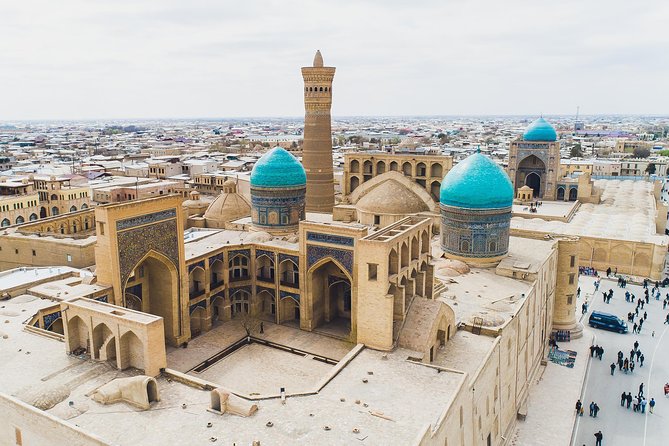
The Kalyan Minaret, Kalyan Mosque, and Mir-i-Arab Madrasa are visited as three separate stops, each with about 30 minutes. Together, they form the most important architectural group of the day.
The Kalyan Minaret is one of Bukhara’s best-known landmarks. Its presence gives the surrounding square a strong vertical focus, while the Kalyan Mosque provides the large religious setting that makes the complex feel substantial.
The Kalyan Mosque dates from the fifteenth century and is one of the city’s major monuments. I like the way the itinerary gives it a separate block of time rather than treating the whole complex as one quick photo stop.
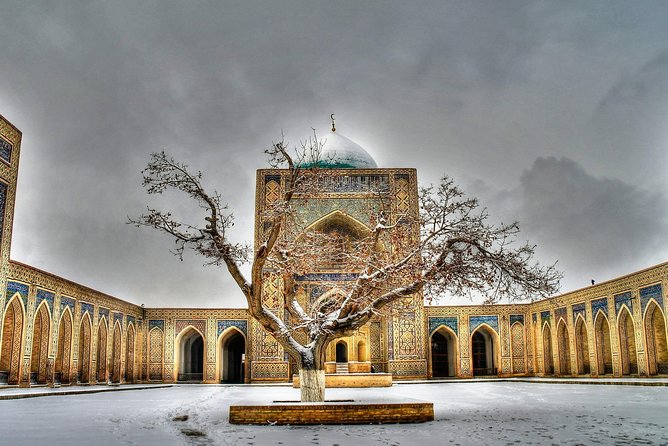
Across the square, Mir-i-Arab Madrasa remains an active religious institution. Future imams and religious mentors study there, so you should follow your guide’s directions about where to look and how to behave. Its continuing role makes it more than a historic shell.
Together, these three stops explain why Bukhara can feel like a city built for scholars, worshippers, and long-distance traders. They are also the part of the route most likely to leave you wishing for another hour.
Ulugbek and Abdulaziz-Khan: two madrassas, two periods
The Ulugbek Madrasa was built in 1417 by the architects Ismail Isfagani and Najmeddin Bukhari. For many years it served as a model for Islamic schools in other Central Asian cities, and its design relies on balanced proportions with restrained decoration.
That restraint is worth noticing. The building does not need a heavy covering of ornament to feel impressive, and a guide can help you see how its layout and proportions create that effect.
The Abdulaziz-Khan Madrasa dates from 1651 to 1652 and is described as the last large madrasa built in Bukhara. Its courtyard follows a familiar four-ayvan composition, but its side spaces and domed structures create a more unusual arrangement.
Seeing these two buildings together gives you a small lesson in architectural change. Ulugbek presents an earlier, more measured style, while Abdulaziz-Khan reflects a later period with a more complex decorative plan.
The Ark Fortress and Bolo Haouz Mosque
The Ark of Bukhara is a citadel and former residence of Bukhara’s khans. Excavations place a citadel on this site as far back as the fourth century BC, and centuries of construction and destruction created the artificial hill that rises about 20 meters.
The scheduled visit lasts 30 minutes. That is enough to understand the Ark’s role and see its imposing exterior, but the tight schedule may limit how much time you spend inside its various areas. Ask your guide to explain the layers of rebuilding, since the fortress you see is the result of many periods rather than one single construction campaign.
Bolo Haouz Mosque sits opposite the Ark in the Registan district. Built in 1712, it is part of the UNESCO-listed historic city along with other monuments in Bukhara.
The mosque offers a useful contrast to the fortress. One represents political power and defense, while the other represents worship and community life. Since both are scheduled for 30 minutes, you can compare them without losing too much time.
The Samanid Mausoleum and Chashma Ayub
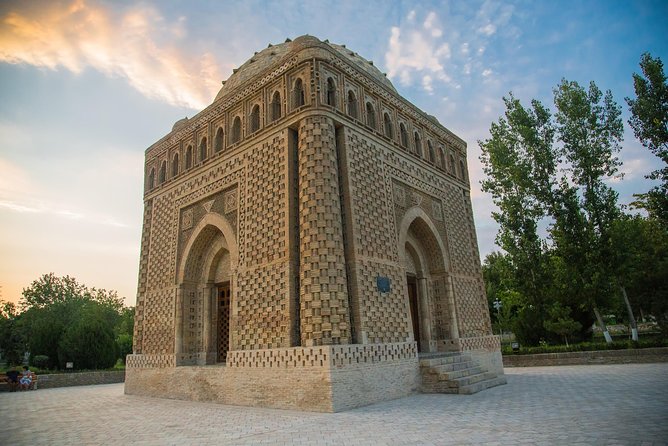
The Ismail Samani Mausoleum is one of the most important early Islamic buildings in Central Asian architecture. Built in the tenth century, it lies northwest of Bukhara’s historic center and is considered the oldest funerary building in the region.
This is a stop where you should slow your eyes down, even if the clock does not allow you to slow your feet. The mausoleum’s importance comes from its age, design, and survival, not from sheer size.
The Chashma Ayub Mausoleum completes the sightseeing route. The religious building includes a mausoleum and a holy spring, and it now contains a Museum of Water.
Its first construction dates to the twelfth century under Karakhanid rulers, but it was rebuilt several times between the fourteenth and nineteenth centuries. The structure was completed during the reign of Tamerlane, giving your guide several periods to connect as you walk through the site.
These final stops add a quieter note after the large squares and fortified walls. They also show how Bukhara’s religious buildings continued to change as rulers, beliefs, and local needs shifted.
What $249 includes, and where the value lies
The price is $249 per person. That is not a low-cost day trip, but it covers the parts that are hardest to arrange independently: the Tashkent to Bukhara train, the Bukhara to Tashkent flight, hotel or airport transfers, a private guide and driver, entrance fees, and lunch.
The return flight is especially important to the value calculation. Booking the train, local transfers, admissions, and a same-day flight separately could take time and create problems if the schedules do not connect.
You are also paying for a private experience. Only your group participates, which can make a real difference when you want to ask questions or adjust the pace. The limitation is that the day remains fixed by transport schedules, so private does not mean leisurely.
Group discounts are offered, which may improve the price for two or more people. Personal expenses and travel insurance are not included, so budget separately for those.
The guide can shape the whole day
The strongest part of the experience is likely to be the guide’s interpretation of Bukhara. The route contains many similar-sounding religious buildings, and without context, Ulugbek, Abdulaziz-Khan, Mir-i-Arab, and Kalyan can blur together.
A well-prepared guide can separate them by date, purpose, design, and present use. One guide named Dilf received especially warm praise for a friendly manner and strong explanations, while another guide was described as making the visit highly educational and informative.
Your driver also matters because the day depends on clean transfers between the station, Old City, airport, and Tashkent arrival point. The operation has been praised for handling both the train ticket and flight ticket smoothly, but you should still confirm the meeting details before leaving the station.
One practical warning is important. A pickup problem at Bukhara station once caused serious stress when the expected sign was not visible. Since taxi drivers may approach you, keep the operator’s contact details available and confirm exactly where the guide will wait.
Who should book this Bukhara day trip?
I would recommend this tour to someone based in Tashkent who has only one free day and wants to see Bukhara without arranging a complicated overnight trip. It also suits first-time visitors who value a guide, included admissions, and door-to-door transport more than free time.
It is a good match for people with moderate physical fitness. You will walk through historic areas, enter multiple monuments, and remain on the move for much of the day.
I would hesitate to recommend it to anyone who wants a slow experience. Several hours on trains and planes, plus sightseeing from late morning through the afternoon, leave little space for sitting in a courtyard, lingering over architecture, or exploring the city independently.
The 92 percent recommendation rate and 4.6 rating from 37 ratings suggest a strong overall experience, but the problems are worth taking seriously. A missed station pickup created an unpleasant start for one person, and a last-minute return-flight shortage caused another booking to fail. The operator offers free cancellation up to 24 hours before departure, but changes made inside that period are not accepted.
Final call: efficient, impressive, and tiring
Book this tour if Bukhara is high on your list and one day is all you have. The train and flight combination, private guide, lunch, admissions, and full Old City route make the $249 cost easier to justify than a bare transport-only excursion.
Skip it if you can spare two or three days. Bukhara deserves more time than this schedule allows, and an overnight stay would let you see the monuments without racing the airport clock.
For the best chance of a smooth day, confirm the station meeting arrangement, keep your expectations realistic, and treat the tour as an ambitious introduction rather than a complete experience of Bukhara.
FAQ
What time does the Bukhara day tour begin?
The transfer to Tashkent Railway Station is scheduled for 6:30 am, and the Afrosiyob high-speed train leaves at 7:30 am.
How long does the train take from Tashkent to Bukhara?
The Afrosiyob train takes about four hours. It is scheduled to arrive in Bukhara at 11:17 am.
How do I return to Tashkent?
You tour Bukhara during the day, then transfer to Bukhara Airport for an economy-class flight back to Tashkent. A transfer from the Tashkent airport to your hotel or home is provided.
Is lunch included?
Yes. Lunch is included in the tour price.
Are entrance fees included?
Yes. Entrance fees for all sightseeing places listed in the tour are included.
Is this a private tour?
Yes. Only your group participates in the activity, and the tour is designed to let you go at your own pace within the day’s transport schedule.
What happens if the high-speed train is unavailable?
The operator says it will replace the Afrosiyob train with the most comfortable class of regular train when necessary.
Recently added around Tashkent
- Tashkent: 3-Day Horseback Riding Tour in Chimgan Mountains★ 4.4 · 3 reviews
- Samarkand: Uloq-Kopkari (Buzkashi) Game Day Tour★ 5.0 · 3 reviews
- Tashkent Mountain Tour Amirsoy with Transport★ 3.5 · 3 reviews
- Private Tashkent City Tour★ 5.0 · 3 reviews
- Amirsoy & Chimgan mountain tour from Tashkent★ 5.0 · 3 reviews
- Transfer Tashkent Airport / Railway Station – Hotel★ 3.5 · 3 reviews
- Heliocomplex “Institute of the Sun” – Remnants of USSR★ 5.0 · 3 reviews
- Half-day excursion around Tashkent★ 5.0 · 3 reviews
Day Trips in Tashkent, compared.
Samarkand One Day Tour – Departure From Tashkent
Read our review →

Samarkand One Day Private Tour from Tashkent with Bullet Train
Read our review →Browse the lists this tour appears in