
Reviewed · TRAIN EXPERIENCES
Uzbekistan 3 Day Private Tour Tashkent-Bukhara-Samarkand Bullet Train
Silk Road history moves fast here. This private three-day tour links Tashkent, Bukhara, and Samarkand by high-speed train, letting you cover Uzbekistan’s great historic centers without arranging each transfer yourself. I like the included bullet train tickets and the local guides assigned in each city. The main drawback is the pace: Bukhara begins after a four-hour morning train ride, and the schedule can feel tight, especially in summer heat.
I also like the practical price, which includes two hotel nights, breakfast, transport in air-conditioned vehicles, monument tickets, and guides. You travel only with your own party, rather than joining a large coach group. But train departures depend on availability, and the first and last station transfers are not included, so you need to plan those pieces carefully.
In This Review
- Key points at a glance
- Why this three-day route works
- Day one: Tashkent to Bukhara by high-speed train
- Poi Kalyan and the heart of old Bukhara
- The Ark and Bolo Hauz Mosque
- Maghak-i Attari and Bukhara’s older layers
- Trading Domes and Lyab-i-Hauz
- Day two: free Bukhara time and the train to Samarkand
- Day three: Samarkand’s grand monuments
- Registan, the essential Samarkand stop
- Gur Emir and the memory of Timur
- Shah-i-Zinda and Bibi Khanym Mosque
- Siab Bazaar and Ulugh Beg Observatory
- Guides, drivers, and the private format
- Hotels, meals, and the real value of $500
- Who should choose this tour?
- Should you book this Uzbekistan tour?
- FAQ
- Where does the tour start?
- Where does the tour end?
- Are hotel nights included?
- Is breakfast included?
- Are the bullet train tickets included?
- Is this a private tour?
- Are monument entrance tickets included?
- What costs extra?
Key points at a glance
- Three Silk Road cities in three days: Tashkent, Bukhara, and Samarkand are connected in one compact route.
- Bullet trains are included: The package covers Tashkent to Bukhara, Bukhara to Samarkand, and Samarkand to Tashkent, subject to availability.
- Private sightseeing: You tour with your own group and receive a licensed guide in each city.
- Bukhara gets the fullest treatment: The first afternoon covers Poi Kalyan, the Ark, Bolo Hauz Mosque, Maghak-i Attari, the Trading Domes, and Lyab-i-Hauz.
- Strong guide feedback: Guides named Muhlio, Malika, Max, Beck, Dilshod, Zinat, Farahat, and Shawkat have been praised for clear English, good local knowledge, and friendly service.
- Good value, with a few extras: Hotels, breakfasts, entrance fees, and train tickets are included, but photography fees, tips, a single-room supplement, and some station transfers cost extra.
Why this three-day route works
Uzbekistan’s famous historic cities are spread across a large country. The train makes this route practical. Instead of losing long hours to road transfers, you travel between the main centers by rail and use local drivers for hotel and sightseeing transfers.
The tour begins at 7:30 a.m. at Tashkent North Railway Station, also called Toshkent Railway Station Shimoliy. You can request pickup if it is easier, but the first morning transfer to the station is not included. The same applies to the final transfer from the station to your hotel or airport.
The private format matters. You can ask questions, move at a reasonable pace for your group, and communicate directly with your guide. You are not waiting for a busload of strangers at every monument. The guides also change by city, which gives you local voices rather than one person trying to explain the whole country.
The tradeoff is obvious: this is a highlights tour, not a slow cultural stay. You get a strong first look at Bukhara and Samarkand, but you will spend much of the three days moving, checking in, and sightseeing. I would choose it for a first visit when time is short, not for a relaxed holiday.
More train journeys from Tashkent:
- 2 Days Tour to Bukhara and Samarkand from Tashkent by train
★ 5.0 · 53 reviews - Tashkent Airport & Train Station Pick Up & Drop Off
★ 4.5 · 50 reviews - Day Tour to Samarkand from Tashkent by train.
★ 5.0 · 34 reviews
Day one: Tashkent to Bukhara by high-speed train
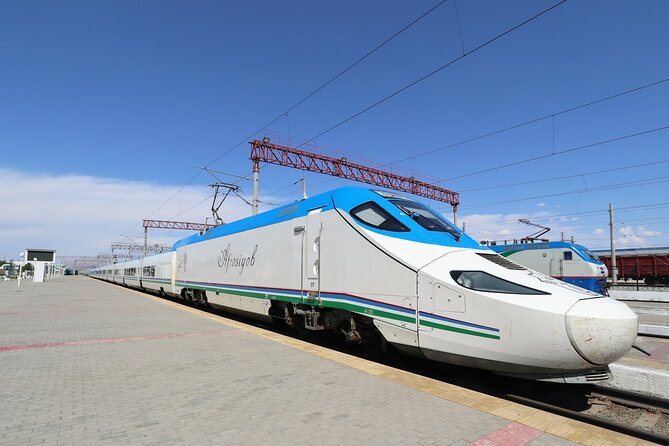
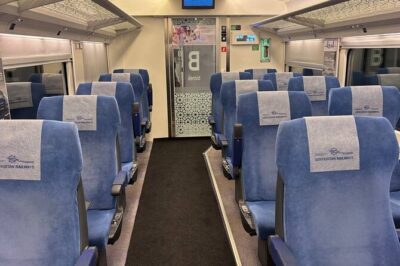
Your first train from Tashkent to Bukhara takes about four hours. The ticket is included, but the departure is subject to availability. This is one of the most useful parts of the arrangement because Uzbekistan’s fast trains are a comfortable and efficient way to cover the distance.
Once you reach Bukhara, a driver meets you at the railway station. The station is in Kagan, about 10 kilometers from Bukhara, so the transfer to your hotel takes another 30 minutes. You check in, meet your Bukhara guide, and begin sightseeing.
That timing is efficient, but it is not gentle. You have an early start, a long train ride, a station transfer, hotel check-in, and then a major walking program. During hot weather, you may find the afternoon demanding. One particularly useful suggestion from the tour’s feedback is to begin Bukhara sightseeing early in the morning during summer, when possible. If you are visiting in very hot conditions, ask the operator whether the order can be adjusted.
Poi Kalyan and the heart of old Bukhara
Poi Kalyan is one of Bukhara’s great visual moments. The Kalyan Minaret reaches 45.6 meters and dates to 1127, making it a survivor from the Kara-Khanid period. It escaped the destruction brought by the Mongol conquests, and that fact gives the site more weight than its graceful brickwork alone suggests.
Allow about an hour here. Your guide can help connect the mosque, minaret, and surrounding buildings to Bukhara’s role on the Silk Road. The appeal is not just the architecture. It is the sense that this square has watched centuries of religious, political, and commercial life pass through it.
The Ark and Bolo Hauz Mosque
Next comes the Ark of Bukhara, a fortress that functioned as a royal town within the city. It was home to Bukhara’s rulers for more than a thousand years. The site takes about an hour and provides a useful counterpoint to the religious buildings: the Ark represents power, administration, and royal life.
Across from it, Bolo Hauz Mosque forms a traditional paired arrangement with the fortress. The name refers to the pool in front of the mosque, and the site is especially appealing for its relationship between water, columns, and the Ark opposite. You spend about 30 minutes here, making it a shorter but worthwhile stop.
More three-day trips from Tashkent:
- 3-Day Chimgan Trekking Tour
★ 5.0 · 10 reviews - Tashkent: 3-Day Horseback Riding Tour in Chimgan Mountains
★ 4.4 · 3 reviews - Desert yurt camp and Mountain tour – 3 days
★ 4.5 · 15 reviews - Aral Sea – Extended trip (3 days)
★ 5.0 · 5 reviews
Maghak-i Attari and Bukhara’s older layers
Maghak-i Attari Mosque is a compact stop of around 30 minutes, but it carries unusual historical depth. The building is associated with earlier Buddhist and Zoroastrian use before becoming a mosque. Its brickwork is a good reminder that Bukhara’s story did not begin with one dynasty or one faith.
This is where a private guide earns the fee. The remains can be easy to pass quickly if you are only looking for grand domes. A good explanation helps you read the building as part of a much older city.
Trading Domes and Lyab-i-Hauz
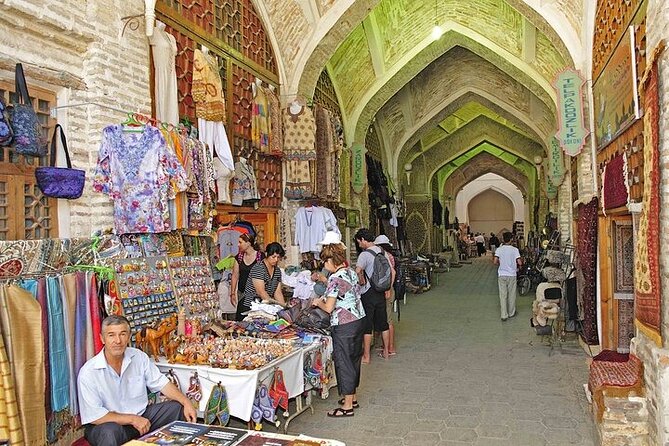
The Trading Domes bring a change of mood. These old market structures still contain artisans’ workshops and offer time to browse without a strict museum feeling. You have about an hour here. It is a sensible place to look at crafts, though you should not feel pressured to buy.
Lyab-i-Hauz receives about two hours and is one of Bukhara’s best places to pause. The ensemble dates mainly from the 16th and 17th centuries and surrounds a pool that remains a focal point. After the day’s monuments, this square gives you room to sit, look around, and absorb Bukhara at a slower speed.
The first day covers a lot. The order is logical, but the heat and walking can wear you down. Wear shoes with good support, carry water, and treat the Lyab-i-Hauz stop as a chance to rest rather than another box to tick.
Day two: free Bukhara time and the train to Samarkand
The second morning is more flexible. You receive free time in Bukhara, or you can choose an optional countryside visit covering the Emir’s Summer Palace, the Naqshbandi Mausoleum, and the Samani Mausoleum. The listed optional program takes about four hours.
This choice depends on your priorities. If the previous afternoon felt rushed, free time lets you revisit a favorite area or enjoy Bukhara without a guide’s timetable. If you want more context beyond the old center, the optional trip adds sites outside the main walking circuit.
In the afternoon, a driver takes you to Bukhara Railway Station in Kagan. The station transfer is about 10 kilometers, then the bullet train to Samarkand takes roughly two hours. After arrival, you are transferred to your Samarkand hotel.
Day two is lighter on scheduled sightseeing, but it still includes a check-out, a station transfer, a train ride, and another hotel arrival. That makes the free morning useful, not empty. You can recover from day one while still seeing more of Bukhara if you wish.
Day three: Samarkand’s grand monuments
Samarkand receives the tour’s main sightseeing day. The schedule includes Registan, Gur Emir, Shah-i-Zinda, Bibi Khanym Mosque, Siab Bazaar, and Ulugh Beg Observatory before your evening train back to Tashkent.
This is another full day, though the individual visits are generally short enough to keep the route moving. Your guide helps place the monuments in the age of Timur and his successors, when Samarkand became a major center of architecture, science, and imperial power.
Registan, the essential Samarkand stop
Registan gets two hours, appropriately so. The square is framed by three madrasas: Ulugh Beg, Sherdor, and Tillokori. It became the city’s main square after life in ancient Afrosiab declined, and it has been rebuilt several times.
You need time here to look at the three facades as a group, then examine the details separately. The scale can be overwhelming at first. A guide can point out the differences between the buildings and explain why Registan became the defining image of Samarkand.
Gur Emir and the memory of Timur
Gur Emir Mausoleum takes about an hour. This is Timur’s tomb, in a beautifully reconstructed building dating from 1404 to 1405. The site connects the conqueror’s political legacy with the architectural style that later shaped other famous monuments in the region.
I would pay attention to the contrast between Timur’s military reputation and the refined design of his mausoleum. The visit is not only about a tomb. It helps explain why Samarkand’s monuments feel so grand and carefully staged.
Shah-i-Zinda and Bibi Khanym Mosque
Shah-i-Zinda is a complex of 44 tombs arranged across more than 20 mausoleums. You have about an hour here. The narrow passage and repeated decorated facades create a very different experience from the open scale of Registan.
Because this is a funerary complex, take your time and follow your guide’s instructions about respectful behavior. The site’s importance comes from both its architecture and its connection with Islamic tradition.
Bibi Khanym Mosque takes about 30 minutes. Built between 1399 and 1404 on Timur’s order and named for his wife, it is one of Central Asia’s best-known architectural sites. The short scheduled visit works as a focused stop, though you may wish you had more time if monumental buildings are your main interest.
Siab Bazaar and Ulugh Beg Observatory
Siab Bazaar is a brief 30-minute visit. Its produce and handicrafts offer a look at everyday commerce rather than royal or religious architecture. This is a good place to notice how the modern city sits beside its historic center.
The final major visit is Ulugh Beg Observatory, with about an hour allotted. Ulugh Beg, Timur’s grandson, was an astronomer, scientist, and architect. Only the foundations remain, but the site gives the day an important change of subject: Samarkand was not only a city of rulers and monuments. It was also a place of scientific study.
After the observatory, you transfer to Samarkand Railway Station and take the bullet train back to Tashkent. The ride takes about two hours. The activity ends back at the original meeting point, but your final transfer to a hotel or airport is not included.
Guides, drivers, and the private format
The strongest part of this experience is the human support. Guides are assigned in each city, and the names praised for their service include Muhlio and Malika in Bukhara, and Max in Samarkand. Beck, Dilshod, Zinat, Farahat, and Shawkat are also singled out for clear English, useful explanations, and personal attention.
Max in particular received strong praise for his Samarkand touring, while drivers such as Mikhail were noted for punctual service. That matters on a schedule built around trains. A late pickup could affect an entire day, so reliable timing is more valuable here than fancy transport.
The private setup also lets you ask for help with practical issues. One booking was rearranged after a delayed visa, and the coordinator worked to preserve the trip during a busy season. That does not remove the need to check your documents early, but it suggests the operator can respond when plans change.
There have also been mistakes. One guest was assigned a double room instead of a twin room, causing stress at check-in. Another had to pay monument entry fees in Bukhara that should have been covered, and the operator offered a $20 refund. These incidents appear to have been handled, but I would confirm your room type and keep receipts for any unexpected payment.
Hotels, meals, and the real value of $500
At $500 per person, the tour is not simply charging for sightseeing. The price includes two nights in a central, well-rated three or four-star hotel or boutique property, twin or double accommodation, two breakfasts, air-conditioned vehicles, monument entry fees, bullet train tickets, licensed guides, taxes, and 24-hour customer service.
That is a strong package for a private three-city route. Buying train tickets, arranging station pickups, booking two hotels, hiring local guides, and paying entrance fees separately would take time and could produce a similar or higher total. The value is greatest for a first-time visitor who wants the main work handled.
Do not expect luxury. The hotels have been described as comfortable and decent rather than high-end, with hospitable staff. A single room costs an additional $40. Museum photography fees of about $1 to $2 per site are not included, and tips for guides and drivers are also extra.
Group discounts may be available, and the ticket is mobile. Confirmation arrives within 48 hours, subject to train and tour availability. Since the rail schedule controls the route, I would not book this as a completely fixed plan until the train seats are confirmed.
Who should choose this tour?
I would recommend it to you if you have only three days, want Bukhara and Samarkand in one trip, and prefer a private arrangement over independent planning. It suits first-time visitors who value English-speaking guides and want entrance fees, hotels, transport, and trains combined in one price.
It is also a good fit for history and architecture fans. The route takes in mosques, madrasas, mausoleums, bazaars, a royal fortress, and an observatory. You get both famous monuments and a few stops that explain older religious and scientific layers.
I would hesitate if you prefer slow mornings, long meals, or independent wandering. The schedule is packed, and the first Bukhara afternoon can be hard in 100-degree Fahrenheit heat. Families or older visitors should ask about adjusting the sightseeing order, especially during summer.
You should also be comfortable with a changing team. You have different guides in Bukhara and Samarkand, plus several drivers. That is useful for local expertise, but the experience may feel less personal than traveling with one guide for the whole trip.
Should you book this Uzbekistan tour?
Book it if your priority is maximum historic coverage in minimum time. The included trains are a major advantage, the private format keeps the days manageable, and the guides and drivers have earned particularly strong praise for English, punctuality, and helpful service.
Before paying, confirm train availability, hotel room configuration, pickup arrangements, and the exact sightseeing hours for hot weather. If those details are clear, $500 buys a well-organized introduction to three of Uzbekistan’s most important cities. If you can add extra days, I would do so, but if three days is all you have, this route makes a practical and worthwhile first visit.
FAQ
Where does the tour start?
It starts at 7:30 a.m. at Toshkent Railway Station, also called Tashkent North Railway Station.
Where does the tour end?
The activity ends back at the meeting point after the Samarkand to Tashkent bullet train journey.
Are hotel nights included?
Yes. The price includes two nights in a central, well-rated three or four-star hotel or boutique hotel.
Is breakfast included?
Yes. Two breakfasts are included.
Are the bullet train tickets included?
Yes. Tickets for Tashkent to Bukhara, Bukhara to Samarkand, and Samarkand to Tashkent are included, subject to availability.
Is this a private tour?
Yes. Only your own group participates in the activity.
Are monument entrance tickets included?
Yes. Entrance tickets to the listed monuments are included. Photography and video charges at museums, usually $1 to $2 per site, are not included.
What costs extra?
Tips, photography and video charges, a $40 single-room supplement, and the first-day morning transfer to the railway station and final-day transfer from the station to your hotel or airport are not included. You can cancel for a full refund up to three full days before the local start time.
Recently added around Tashkent
- Tashkent: 3-Day Horseback Riding Tour in Chimgan Mountains★ 4.4 · 3 reviews
- Samarkand: Uloq-Kopkari (Buzkashi) Game Day Tour★ 5.0 · 3 reviews
- Tashkent Mountain Tour Amirsoy with Transport★ 3.5 · 3 reviews
- Private Tashkent City Tour★ 5.0 · 3 reviews
- Amirsoy & Chimgan mountain tour from Tashkent★ 5.0 · 3 reviews
- Transfer Tashkent Airport / Railway Station – Hotel★ 3.5 · 3 reviews
- Heliocomplex “Institute of the Sun” – Remnants of USSR★ 5.0 · 3 reviews
- Half-day excursion around Tashkent★ 5.0 · 3 reviews
Train Experiences, compared.
2 Days Tour to Bukhara and Samarkand from Tashkent by train
Read our review →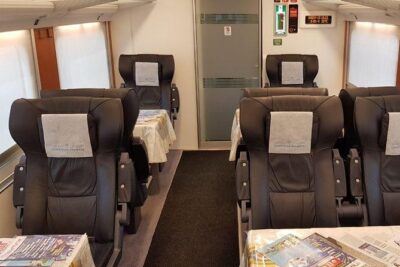
Afrosiyob high speed train tickets – Guaranteed Pass
Read our review →
Samarkand One Day Private Tour from Tashkent with Bullet Train
Read our review →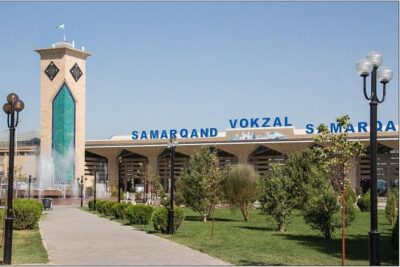
Samarkand Airport / Railway Station – Samarkand City Transfer
Read our review →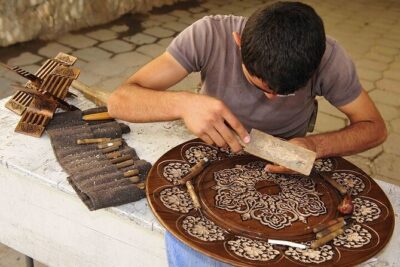
Uzbekistan 6 Days Private Tour Khiva-Bukhara-Samarkand by Train
Read our review →
Transfer Tashkent Airport / Railway Station – Hotel
Read our review →Browse the lists this tour appears in