
Reviewed · PRIVATE
6- Day Private Tour to Tashkent, Khiva, Bukhara and Samarkand
Four Silk Road cities, six busy days. This private Uzbekistan tour packs Tashkent, Khiva, Bukhara, and Samarkand into one carefully arranged route, using a domestic flight, intercity trains, hotel transfers, local guides, and included entry fees. I like the efficient city-to-city plan and the fact that you travel with only your own group, rather than being folded into a large coach tour. I also like the strong practical support, with hotel-to-hotel transport and a tour coordinator available for help.
The trade-off is simple: this is a fast trip. You will see the main monuments, but you will not have much spare time in each city. The early airport transfer on Day 2, long train rides, and full sightseeing days require energy. If you want a slow look at Uzbek neighborhoods and daily life, six days will feel tight.
In This Review
- Key things to know before booking
- What $765 buys you across Uzbekistan
- Day 1: A soft landing in Tashkent
- Day 2: Khiva’s walled city and the flight to Urgench
- Day 3: Crossing the Kyzylkum Desert by train
- Day 4: Bukhara’s mosques, fortress, and trading center
- Day 5: Samarkand’s grand monuments and blue-tiled squares
- Day 6: Tashkent’s old quarter, museums, and metro
- Transport, pacing, and guide support
- Who should book this private Uzbekistan tour?
- Should you book it?
- FAQ
- How long is the private Uzbekistan tour?
- What is the price per person?
- Is the tour private?
- Are airport and hotel transfers included?
- Which transport is used between the cities?
- Are train tickets included?
- Are meals included?
- Are hotel stays included?
- Can the itinerary be customized?
Key things to know before booking
- It covers Uzbekistan’s four essential historic cities: Tashkent, Khiva, Bukhara, and Samarkand.
- The route uses several forms of transport: a domestic flight to Urgench, trains, private road transfers, and air-conditioned vehicles.
- It is genuinely private: only your own party takes part in the tour.
- Five nights in 3-star hotels are included: this keeps the $765 price practical, though meals are mostly extra.
- The schedule begins early: the Day 2 transfer to Tashkent airport is planned for 5:00 a.m.
- Train tickets need early planning: high-speed seats may be unavailable inside 60 days of departure.
What $765 buys you across Uzbekistan
At $765 per person, this tour offers a useful bundle rather than just sightseeing. The price includes five hotel nights, domestic air travel from Tashkent to Urgench, train tickets, private transfers, guides, entry fees, and an expert tour director. You also receive one lunch at Besh Qozon, a major plov restaurant in Tashkent.
That matters in Uzbekistan, where arranging several different transport legs can take time. You do not need to work out how to reach Khiva from Urgench, find a driver at Bukhara station, or organize transfers between hotels and railway stations. The basic movement of the trip is handled for you.
The value is strongest if you want an overview of the country’s major monuments in a short holiday. Buying domestic transport, hotels, admissions, and private guiding separately could be more work, even if some independent arrangements cost less. The price does not include lunch and dinner in general, and an e-visa, if required, is also extra, so you should budget beyond the advertised amount.
The five included hotels are described as the best available 3-star properties. That suggests practical rather than luxurious lodging. You get a base for sleeping and washing up, but the main investment is in the route and sightseeing, not upscale accommodation.
The tour also includes group discounts and mobile ticketing. Pickup is offered, and confirmation is provided at booking. Since it is commonly reserved well ahead of departure, booking around 50 days in advance is sensible. In practice, I would book earlier if train times and a preferred guide language matter to you.
A few more Tashkent trips worth weighing up
- Best of Tashkent Mountains: Amirsoy, Chimgan & Charvak Trip
★ 4.8 · 567 reviews - Samarkand One Day Tour – Departure From Tashkent
★ 5.0 · 313 reviews - Samarkand One-Day Tour Departure from Tashkent
★ 4.7 · 171 reviews
Day 1: A soft landing in Tashkent
Your first day is deliberately light. A driver meets you at Tashkent International Airport and takes you to the hotel. The plan then gives you time to rest.
That is a good choice. Uzbekistan’s main sights are spread across the country, and the following day begins before sunrise. Rather than adding a rushed city tour after your flight, the schedule lets you recover and prepare for Khiva.
The meeting time for the wider program is listed as 7:00 a.m., but your airport arrival details will control the first transfer. Confirm your flight information and hotel arrangements at booking so the pickup is clear.
Day 2: Khiva’s walled city and the flight to Urgench
This is the trip’s toughest morning. A 5:00 a.m. transfer takes you to Tashkent airport for a 7:00 a.m. flight to Urgench. After landing at about 8:30 a.m., your driver takes you to Khiva, with arrival planned around 9:30 a.m.
The reward is Itchan Kala, Khiva’s inner fortified city. Its walls enclose more than 50 historic monuments, and the compact setting makes it one of the easiest places on this route for you to explore on foot. The six-hour visit gives you a proper introduction rather than a quick photo stop.
You will also see the Islam Khodja Complex, one of Itchan Kala’s major religious and architectural sites. The complex includes a madrasah and minaret, and it was the first Uzbek site placed on the UNESCO World Heritage List in 1990.
The Kunya-Ark Citadel was the residence of Khiva’s khans. Allow yourself time to picture this not as one isolated building, but as a former seat of power within the fortified city. The scheduled visit is only 30 minutes, so your guide’s explanation will help you understand what you are seeing quickly.
Kalta Minor is the eye-catching stop. Its broad, turquoise-tiled tower was begun in 1851 by Mohammed Amin Khan. Local legend says he wanted a minaret tall enough to see Bukhara, but he died before it was completed. The unfinished tower is one of Khiva’s most recognizable sights.
The day finishes with a hotel transfer and rest. That rest is not optional for most people. You have flown, transferred, walked through a stone-built old city, and started sightseeing shortly after breakfast.
Day 3: Crossing the Kyzylkum Desert by train
After breakfast, you transfer to Khiva railway station at 10:00 a.m. The planned 11:10 train reaches Bukhara at about 6:14 p.m., giving you roughly seven hours on the move.
This is not dead time. The train route passes through the Kyzylkum Desert and follows part of the old Silk Road corridor. You will not be visiting ruins from the carriage, but the changing view gives useful context for the distances between these cities. Uzbekistan is large enough that the train journey becomes part of the experience.
The details describe this leg as a regular train. Other rail tickets on the tour may be high-speed, depending on availability. The train arrangement can change if seats are sold out, and the tour notes that high-speed tickets may be unavailable when booked less than 60 days before departure. In that case, the operator may provide a comfortable regular train or other transport.
On arrival in Bukhara, a driver meets you at the station and takes you to the hotel. The evening is free. This is one of the few open stretches in the schedule, so use it for a short walk, a relaxed meal, or an early night.
A completely different sort of day around Tashkent:
- Tashkent: Amirsoy Resort, Chimgan Mountain and Charvak Lake
★ 4.8 · 170 reviews - Explore Amirsoy, Chimgan & Charvak – A Full-Day Mountain Tour
★ 5.0 · 158 reviews - Tashkent City Tour
★ 5.0 · 121 reviews - Tajikistan : Exclusive Seven Lakes Day Tour From Samarkand
★ 4.9 · 102 reviews
Day 4: Bukhara’s mosques, fortress, and trading center
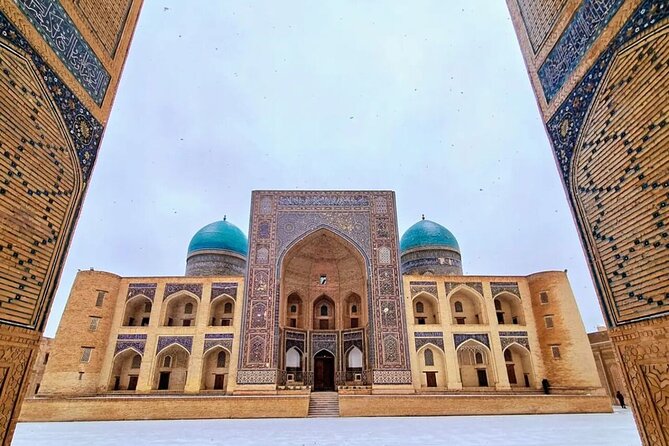
Bukhara receives the fullest sightseeing treatment. You meet your guide at 9:00 a.m. and spend the morning and early afternoon moving among religious buildings, old trading areas, and the city’s central pool.
Start with Lyab-i-Hauz, a gathering place built around a pool and bordered by the Nadir Divanbegi Madrasa, a khanaka, and the Kukeldash Madrasa. A monument to Khodja Nasreddin adds a lighter note to the setting. The scheduled 45 minutes is enough for an introduction, but you may wish you had longer to sit and watch local life.
The Ark of Bukhara is a huge fortress with several museums inside. The schedule allows 30 minutes, although the fortress itself can take about two hours to examine fully. Treat this as a highlights visit, not a complete museum tour. If you are especially interested in the Ark’s exhibits, ask your guide which rooms deserve priority.
Bolo Hauz Mosque is known for its tall carved wooden pillars at the entrance. The structure and its pond offer a useful change from the larger monuments, and the 30-minute stop keeps the day moving.
At Chor Minor Madrasa, four small towers topped with blue domes give the building its unusual shape. It is a short visit, but a memorable one. The name means four minarets in Tajik, although the building’s role and form are more complex than that simple label suggests.
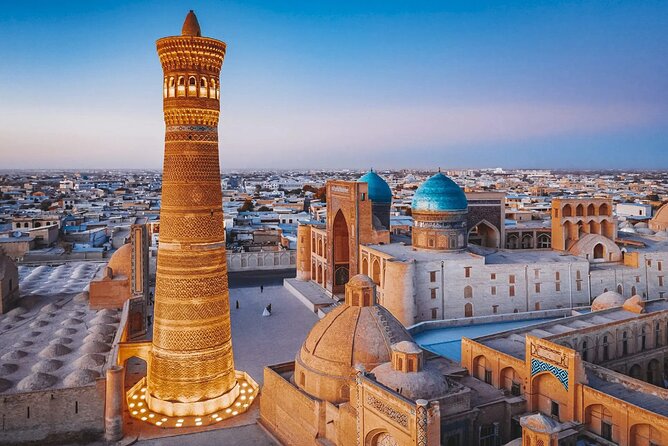
The major religious complex is Poi Kalyan, whose name means at the foot of the great. The group includes the Kalyan Mosque, the Great Minaret of the Kalon, and the Mir-i-Arab Madrasa. The buildings were created across the 12th to 16th centuries, so you are seeing several periods gathered into one powerful city view.
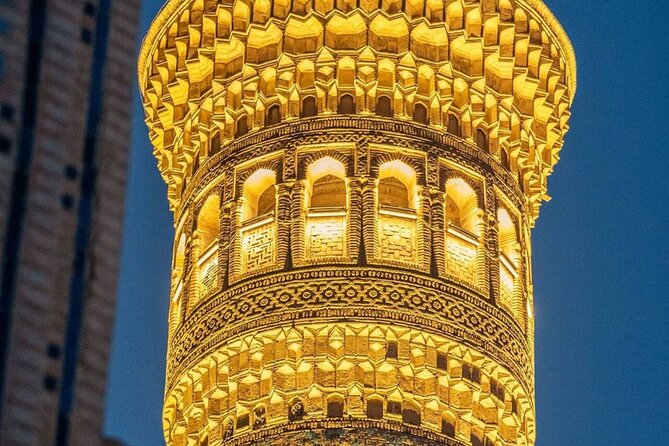
The Great Minaret of the Kalon is Bukhara’s landmark. Give yourself a moment to look up before moving on. The scale of the tower helps explain why it has served as a marker for the city for centuries.
Mir-i-Arab Madrasa remains an operating religious school and includes the shrine of Mir Arab. That makes this more than a decorative monument. Dress respectfully and follow your guide’s instructions about where you may go.
The route also includes the Ulugbek Madrasa, built in 1417 by the astronomer and ruler Mirzo Ulugbek. It is described as the oldest surviving madrasa in Central Asia, giving the stop particular importance for anyone interested in education and science as well as religious architecture.
You leave Bukhara railway station at about 4:24 p.m. for Samarkand and arrive around 6:07 p.m. The train saves you from a long road transfer and lets you reach Samarkand the same evening. You then transfer to your hotel for the night.
Day 5: Samarkand’s grand monuments and blue-tiled squares
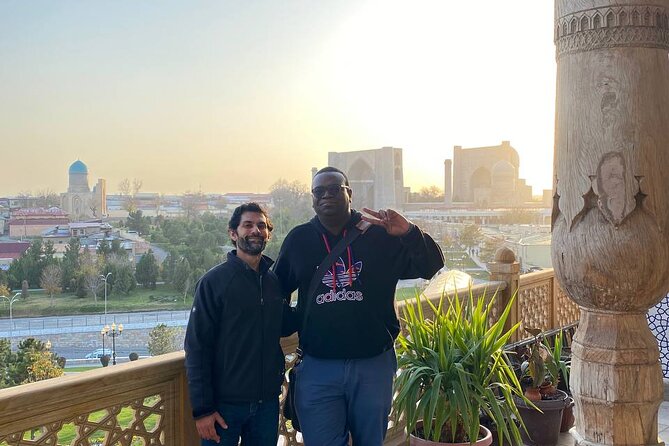
Samarkand is the most visually grand part of the route. Your guide meets you at 9:00 a.m., and the day covers the city’s best-known monuments before an evening train back to Tashkent.
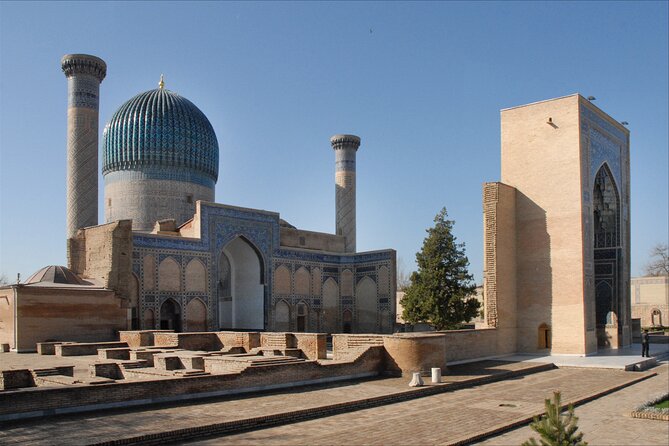
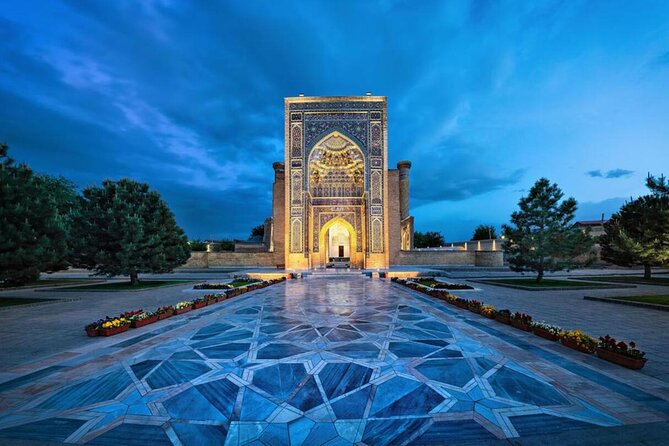
Gur Emir Mausoleum is the first stop. Its domed complex contains the tombs of Tamerlane, the ruler better known locally as Amir Temur. The building sets up an important theme for Samarkand: political power expressed through scale, geometry, and careful decoration.
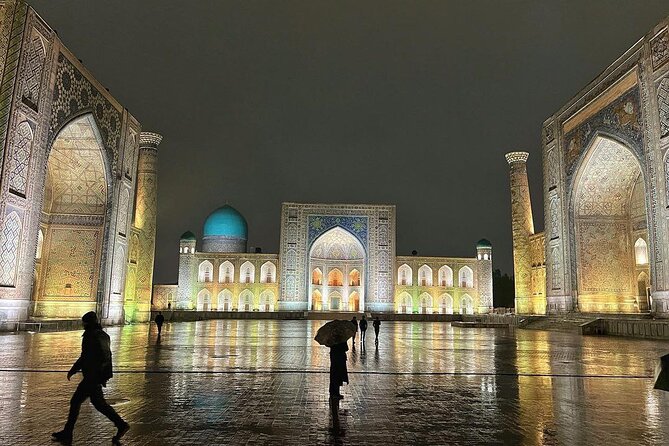
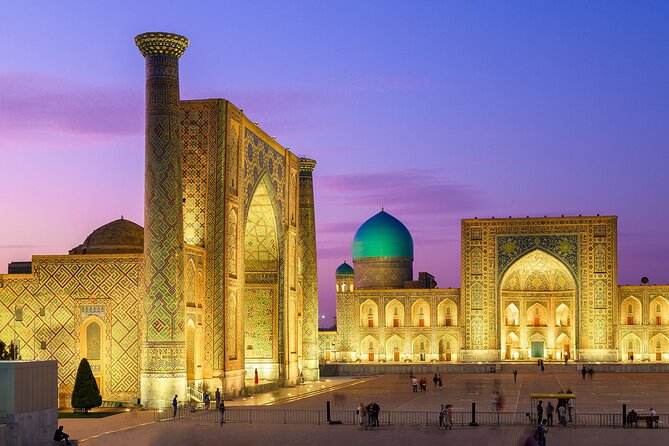
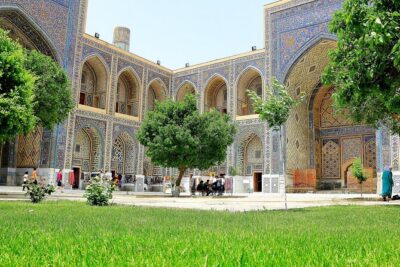
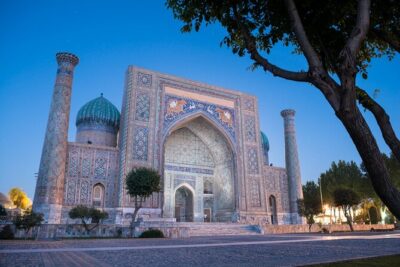
Then comes Registan, the city’s main square and one of Central Asia’s great architectural scenes. Three monumental schools surround the plaza: Ulughbek Madrasa, Sherdor Madrasa, and Tilla Kori Madrasa. The planned one-hour visit gives you time to look at the facades and hear how the three buildings relate to one another, though an extra hour would be welcome for careful photography and interior details.
Bibi Khanym Mosque recalls the power of the Timurid period. In the 15th century, it ranked among the largest mosques in the Islamic world and is regarded as a major work of the Timurid Renaissance. The site is close to Siyob Bazaar, making the transition from monument to everyday commerce especially useful.
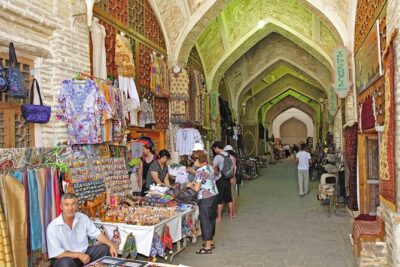
At Siyob Bazaar, you can see where daily shopping happens and look for Samarkand naan, the city’s famous bread. The one-hour stop is one of the tour’s better chances to experience local food culture rather than only historic buildings. Lunch is generally not included, so the bazaar may also be a practical place to buy something to eat.
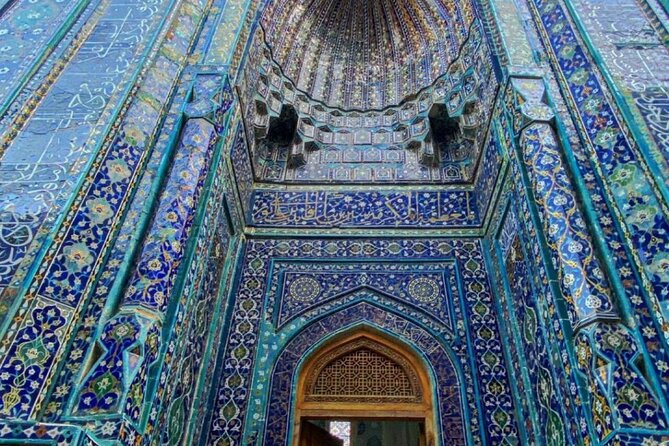
Shah-i-Zinda is an ensemble of mausoleums and ritual buildings from the 11th to 15th centuries, with later additions from the 19th century. The complex is intimate and devotional compared with Registan’s open grandeur. Wear shoes you can walk in, since the route through Samarkand includes several substantial stops.
The final monument is the Ulugh Beg Observatory, built in the 1420s by the Timurid astronomer Ulugh Beg. This stop adds science to the usual royal and religious story. It reminds you that Samarkand was also a center for serious astronomical work.
At 6:00 p.m., you transfer to the station for the 6:32 p.m. train to Tashkent, arriving around 8:45 p.m. The day is full, and the evening return means you will likely want a quick meal and sleep rather than a late outing.
Day 6: Tashkent’s old quarter, museums, and metro
Your final morning begins at 9:00 a.m. with a full tour of Tashkent. The capital differs from Khiva, Bukhara, and Samarkand. It is a modern city with historic religious sites, broad public squares, museums, markets, and an underground railway.
Kukeldash Madrasa, built in 1570 under the Shaybanid dynasty, reconnects you with the architectural tradition seen elsewhere in Uzbekistan. Amir Temur Square and the Amir Timur Museum then focus attention on the country’s most famous conqueror and political figure. The museum’s central rotunda includes a copy of the Quran, a painted mural, a gold-colored domed ceiling, and a large chandelier.
The Hazrati Imam religious center includes Barakkhan Madrasa, the Kaffal Shashi Mausoleum, and a library of Islamic literature. It also houses the seventh-century Quran associated with Caliph Uthman. This is an important stop, but it is a religious center, not simply a museum. Respectful clothing and quiet behavior are appropriate.
Chorsu Bazaar gives you another close look at daily trade. Its name means four waters and refers to the meeting of four parts of the old city. The market is a practical place to see food and goods being sold, and it balances the formal monuments with ordinary city life.
Independence Square reflects the country’s past, present, and future through fountains, public buildings, and an eternal flame honoring soldiers. The Courage Earthquake Memorial recalls the April 26, 1966 earthquake and the people affected by it. Together, these two stops add modern national history to the older Silk Road narrative.
The program also lists Minor Mosque, the Museum of Applied Art, and the Tashkent metro. The museum contains more than 4,000 decorative-art exhibits, while the metro stations are known for individual architectural and artistic designs. These additions are worthwhile because they show that Tashkent is not merely a gateway to older cities.
Finally, your driver takes you to Tashkent International Airport. The timing of this transfer depends on your departure flight, so confirm the final pickup hour with the coordinator.
Transport, pacing, and guide support
The transport plan is one of the tour’s main strengths. You combine a domestic flight, regular or high-speed rail depending on availability, and private transfers in air-conditioned vehicles. Hotel-to-station and station-to-hotel arrangements remove much of the uncertainty that can make a multi-city trip tiring.
The pace is still demanding. Day 2 begins at 5:00 a.m., Day 3 includes a seven-hour train, and Days 4 and 5 combine full sightseeing with evening rail journeys. If you have limited mobility or dislike frequent hotel changes, ask about customizing the route.
Only your own group participates, which gives the guide more room to adjust explanations and deal with practical problems. Strong customer service and prompt help from the tour coordinator are important here, especially when flights, trains, and transfers must line up. Guide language can be an issue if you book less than 60 days before departure, since a requested language may not be available and an English-speaking guide may be substituted.
The tour can be customized. That is useful if you want more time in Bukhara, fewer museum stops, or a slower schedule. The route’s main sights are already selected, but customization may be the best way to make the six days fit your interests.
Who should book this private Uzbekistan tour?
I would choose this trip if you want to see the major Uzbek cities in one compact holiday and prefer having transport, hotels, guides, and admission fees arranged together. It suits first-time visitors who want structure, couples or families who value a private group, and anyone who does not want to manage several rail and road connections alone.
I would hesitate if your main goal is unhurried travel. Khiva, Bukhara, and Samarkand each deserve more than a day, and this plan gives you highlights rather than long stays. Independent travelers who enjoy choosing small restaurants, wandering without a clock, and changing plans at the last minute may prefer a longer itinerary.
Free cancellation is available up to 24 hours before the start time for a full refund. Inside that window, changes and refunds are not accepted. Check the local cutoff time before making last-minute plans.
Should you book it?
Book this tour if your priority is maximum coverage in six days. The $765 price is reasonable for a private route that includes hotels, transport, guides, admissions, and a domestic flight, especially when you factor in the time saved on planning.
Before booking, confirm three things: your preferred guide language, the available train class, and the exact hotel and airport schedule. If you can handle early mornings and full sightseeing days, this is a practical first look at Uzbekistan’s four essential cities. If you want lingering meals, quiet streets, and slower cultural contact, add several nights or customize the route rather than trying to squeeze more into the same six days.
FAQ
How long is the private Uzbekistan tour?
The tour lasts approximately six days and includes Tashkent, Khiva, Bukhara, and Samarkand.
What is the price per person?
The listed price is $765 per person.
Is the tour private?
Yes. Only your own group participates in the activity.
Are airport and hotel transfers included?
Yes. The tour includes hotel-to-hotel transfers and full transportation in air-conditioned vehicles. Airport pickup in Tashkent is also provided.
Which transport is used between the cities?
The route includes a domestic flight from Tashkent to Urgench, a train from Khiva to Bukhara, a train from Bukhara to Samarkand, and a train from Samarkand to Tashkent.
Are train tickets included?
Yes. Train tickets are included. High-speed train tickets may be unavailable when booking less than 60 days before departure, in which case they may be replaced with comfortable regular train tickets or other transport.
Are meals included?
Most lunches and all dinners are not included. One lunch at Besh Qozon in Tashkent is included.
Are hotel stays included?
Yes. The price includes five nights in 3-star hotels.
Can the itinerary be customized?
Yes. The tour can be customized. You should request changes before departure so the operator can check transport and guide availability.
Recently added around Tashkent
- Tashkent: 3-Day Horseback Riding Tour in Chimgan Mountains★ 4.4 · 3 reviews
- Samarkand: Uloq-Kopkari (Buzkashi) Game Day Tour★ 5.0 · 3 reviews
- Tashkent Mountain Tour Amirsoy with Transport★ 3.5 · 3 reviews
- Private Tashkent City Tour★ 5.0 · 3 reviews
- Amirsoy & Chimgan mountain tour from Tashkent★ 5.0 · 3 reviews
- Transfer Tashkent Airport / Railway Station – Hotel★ 3.5 · 3 reviews
- Heliocomplex “Institute of the Sun” – Remnants of USSR★ 5.0 · 3 reviews
- Half-day excursion around Tashkent★ 5.0 · 3 reviews
Private, compared.
Private Samarkand City Tour With Transportation
Read our review →
Full Day Private Tour in Seven Lakes from Samarkand
Read our review →
Uzbekistan 6 days private tour Tas-Khiva-Buk-Sam-Tas
Read our review →
Browse the lists this tour appears in