
Reviewed · FULL-DAY
Best of Bukhara: All Day Private Old Town Tour
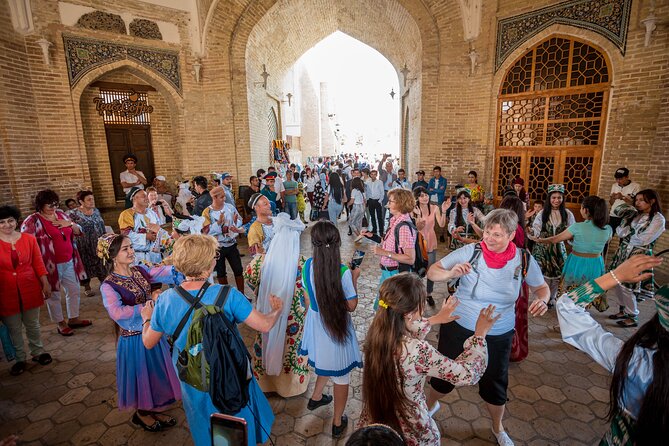
Bukhara rewards slow looking. This private walking tour brings the city’s grand mosques, old trading domes, madrasas, and Jewish quarter into one well-planned day, with a local guide to explain what you are seeing. I especially like the private format, which lets you ask questions and set a comfortable pace, and the wide range of sights, from the massive Ark fortress to small craft shops and the old synagogue. The main drawback is that the $65 price does not include entrance fees, although the listed museum and historic-site charges add only about $6 per person.
I also like that hotel pickup is offered and that the tour covers the Old Town on foot rather than keeping you behind a vehicle window. Guides such as Shakhnoza, Bekhruza, Malika, Nargiz, and Shehnaz have been praised for clear English, local insight, and flexibility. Still, this is a packed day, and the frequent stops, uneven historic buildings, and stairways may feel tiring if you have limited mobility.
In This Review
- Key points at a glance
- Why this Bukhara tour works well
- Starting at Lyab-i-Hauz
- The Kalon Minaret and Poi Kalyan
- The Ark and Bolo Hauz Mosque
- Trading domes, crafts, and shopping
- Nodir Devon Begi and Maghak-i Attari
- Ulugbek and Abdulaziz-Khan Madrasas
- Bukhara’s Jewish quarter and synagogue
- Guides, pace, and the walking load
- Is $65 good value?
- Who should book this experience?
- Should you book the Bukhara Old Town tour?
- FAQ
- How much does the Best of Bukhara tour cost?
- How long does the tour last?
- Is hotel pickup included?
- Is this a private tour?
- Are entrance fees included?
- Which Bukhara sights are included?
- Is the tour mostly a walking tour?
- Can most people participate?
- What is the cancellation policy?
Key points at a glance
- Thirteen major Old Town stops: See the Ark, Kalon Minaret, Poi Kalyan, trading domes, madrasas, mosques, and Bukhara’s synagogue in one outing.
- A genuinely private experience: Only your group takes part, so the guide can adjust the pace and answer your questions.
- Strong local guiding: Shakhnoza, Bekhruza, Malika, Nargiz, and other named guides have earned praise for English, history, culture, and practical city advice.
- Mostly a walking day: Pickup may involve a local taxi to the center, then you explore the historic core on foot.
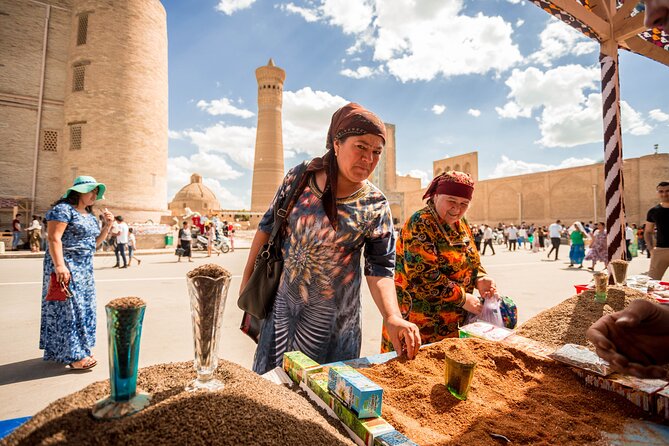
- Good shopping context: The route includes trading domes, bazaars, textiles, carpets, spices, and artisan workshops.
- Budget for entry charges: The tour price is $65 per person, with about $6 more listed for museums and historic sites.
Why this Bukhara tour works well
Bukhara is easy to admire and surprisingly easy to misunderstand. A blue-tiled dome may look like a pretty backdrop, but it can also point to a religious school, a mosque complex, or a building shaped by centuries of trade. A private guide gives those places a clear thread.
The tour is designed as a broad introduction to the Old Town. You are not spending the whole day inside one museum or following a narrow theme. Instead, you move between public squares, religious buildings, a fortress, market halls, and a historic neighborhood.
That range is the biggest strength. You get the famous sights, but you also see how Bukhara worked as a city. The trading domes show commerce. The madrasas show education and religion. The Ark shows power. The synagogue adds another part of the city’s past.
The private setup matters, too. Guides have adjusted timing for delayed trains, walking difficulties, and special interests. One guide paid for a tuk-tuk when the walk ended some distance from the starting point. Another added the Ismail Samani Mausoleum after a schedule change. These examples suggest a useful level of flexibility, though you should confirm any special request before the tour begins.
More full-day trips from Bukhara:
- Best of Bukhara: All Day Private Old Town Tour
★ 4.9 · 62 reviews - Bukhara Full Day Old City Private Tour
★ 5.0 · 46 reviews - Bukhara: Full-Day Guided Tour with English-Speaking Guide
★ 5.0 · 4 reviews
Starting at Lyab-i-Hauz
Lyab-i-Hauz, meaning at the pond, is one of the best places to begin getting your bearings. The square belongs to a 16th and 17th-century architectural ensemble and sits in the southeast part of Bukhara’s Old Town.
Allow about 30 minutes here. This is not just a quick photo stop. The pond and surrounding buildings give you a feel for how public life once gathered around water, shade, religion, and trade.
The nearby Monument to Hodja Nasreddin adds a lighter touch. The bronze figure was installed in 1979 and is connected with the humorous folk character Nasreddin Khoja. The stop lasts about 20 minutes and is included in the route.
Lyab-i-Hauz also helps you understand the scale of the day. From here, the tour moves through compact historic streets and pedestrian-friendly roads, but the number of stops means you will want comfortable shoes and water.
The Kalon Minaret and Poi Kalyan
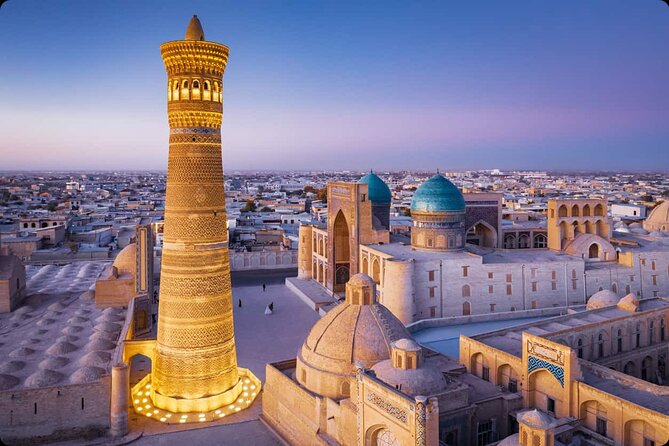
The Great Minaret of the Kalon is the image many people carry in their heads before arriving in Bukhara. It is part of the Poi Kalyan religious complex and is one of the city’s most important landmarks.
The minaret stop lasts around 30 minutes. The listed admission is not included, so keep small extra costs in mind. Your guide can help you read the complex as more than a single tower, explaining its place beside the Kalan Mosque and Mir-i-Arab Madrasa.
Poi Kalyan receives another 30 minutes. The three-part complex includes the Kalan Mosque, the Kalan Minaret, and Mir-i-Arab Madrasa. Seeing these elements together is valuable because the scale and relationship between them are difficult to grasp from photographs.
Mir-i-Arab Madrasa gets about 20 minutes. Its story reaches into the Soviet period, when it was the only spiritual educational establishment in the USSR to resume operation after the Second World War. The building offers a useful way to connect Bukhara’s older religious traditions with its modern political past.
Some of these sites charge admission, and access can vary by building. The tour includes viewing them, but the $65 does not cover entrance tickets. The supplied cost estimate for museums and historic sites is $6 per person.
The Ark and Bolo Hauz Mosque
The Ark of Bukhara deserves the longest single stop, about one hour. This huge fortress was initially built and occupied around the fifth century AD, and it served as a seat of power for Bukhara’s rulers.
The Ark is the sort of place where a guide adds real value. On your own, you may see thick walls, gateways, and open courtyards. With context, you can better understand how the fortress functioned as a political center and why its position matters within the old city.
The tour allows only 10 minutes for Bolo Hauz Mosque, built in 1712 opposite the Ark in the Registan district. That is enough for a focused exterior look and perhaps a short explanation, but not a leisurely visit. If mosque interiors or architectural detail are a priority for you, ask your guide how much time can be shifted from another stop.
The pairing of the Ark and Bolo Hauz is one of the day’s smart choices. The fortress represents authority and defense, while the mosque reflects religious life nearby. Together, they make the area more understandable than either building alone.
A few more Bukhara trips worth weighing up
- Bukhara: Walking Tour with a Small Group
★ 4.9 · 260 reviews - From Bukhara: 2-Day Desert Yurt Camp Tour
★ 4.5 · 57 reviews - City Tour Around Bukhara
★ 5.0 · 55 reviews - Bukhara: Historic Center Guided Sightseeing Tour
★ 4.8 · 44 reviews
Trading domes, crafts, and shopping
Bukhara’s trading domes are among the most enjoyable parts of the route. Four ancient domes remain, positioned along a north to south route through the Old Town. The tour gives them about 30 minutes, with no admission charge listed.
These market halls are a good place to slow down and look closely. Uzbekistan is known for hand-woven textiles, and Bukhara is a useful stop for carpets, spices, and souvenirs. You may also encounter artisan workshops featuring metal carving, carpet weaving, and miniature painting, depending on the guide and your interests.
Shopping is more pleasant when you understand what you are seeing. A private guide can explain the difference between a quick souvenir stop and a craft with real local work behind it. Several guides have also offered suggestions for markets, food, and places to visit beyond the main route.
Still, keep your buying decisions in your own hands. The supplied experiences describe guides as helpful rather than pushy, but you should feel free to browse without purchasing. If you have a particular interest in textiles, metalwork, or miniature painting, mention it at the start.
Nodir Devon Begi and Maghak-i Attari
Nodir Devon Begi Madrasa was built in 1622 and 1623 by the vizier of Imamkuli-khan. It first operated as a caravanserai before being converted into a madrasa.
The 20-minute stop gives you a compact lesson in how buildings changed roles as Bukhara’s needs changed. A caravanserai served merchants and trade, while a madrasa served religious education. That connection makes this stop especially useful after the trading domes.
Maghak-i Attari Mosque receives about 30 minutes and forms part of the Lyab-i-Hauz religious complex. It is another reminder that Bukhara’s historic center is not a collection of isolated monuments. Religious, commercial, and social spaces sit close together.
Admission is not included at either site. Ask your guide which interiors are open on the day of your visit and how the entrance fee will be handled. The published information confirms extra charges for museums and historic places, but it does not give a separate price for every building.
Ulugbek and Abdulaziz-Khan Madrasas
The Ulugbek Madrasa was completed in 1420. Its details include exterior tiles, a fluted dome, stained windows, and old tombs, with about 30 minutes set aside for the visit.
Ulugbek was not only a ruler but also a scholar and supporter of science. That background gives the building a wider meaning. Bukhara was not only a stop for merchants and pilgrims. It was also a place where teaching and scholarship mattered.
The Abdulaziz-Khan Madrasa receives another 30 minutes. The supplied description links it with Ulugbek’s first madrasa, built in Bukhara in 1417. Seeing the two institutions on the same day lets you compare different periods of madrasa architecture and patronage.
This portion can feel dense if you are not interested in architectural history. I would ask your guide to point out two or three details worth remembering rather than trying to memorize every date. The private format should make that kind of conversation possible.
Bukhara’s Jewish quarter and synagogue
The Bukhara Synagogue is scheduled for about 20 minutes. It provides a different view of the city’s past and takes you into the old Jewish quarter.
The supplied information notes that, before the synagogue was built, Bukhara’s Jews prayed together with Muslims in the same mosque. That detail gives the stop social importance beyond its religious function. It also helps broaden the day beyond the better-known Islamic monuments.
One guide showed the old Jewish quarter and a synagogue described as dating to the 16th century. The exact access and time inside can depend on conditions, so treat this as a meaningful short visit rather than a long museum tour.
For many visitors, this is one of the stops most likely to be missed when exploring alone. The guide’s local knowledge helps you place it within the wider story of Bukhara.
Guides, pace, and the walking load
The strongest part of this experience is the guiding. Names that appear repeatedly in the supplied material include Shakhnoza, Shaknoza, Shahnoza, Bekhruza, Malika, Nargiz, Shehnaz, Sittora, and Shaherzat. The spelling varies, but the praise is consistent: clear English, strong knowledge of Bukhara, friendly manner, and useful advice about food, shopping, and extra sights.
You should not assume a specific guide unless GM TOURS confirms one. What you can reasonably expect is a local professional guide, with the tour conducted privately for your group.
The pace can be adjusted. Guides have accommodated older family members, spinal-surgery recovery, walking problems, delayed trains, and requests for extra craft workshops. That does not remove the physical demands of the day, though. You will walk between many historic buildings, and some sites may include stairs or uneven surfaces.
The published duration is approximately five to seven hours. One outing ran from 8:00 a.m. to 1:30 p.m., while another covered the main sights in about six hours. In practice, the length depends on your start time, walking pace, entrance stops, questions, and any added visits.
Pickup is offered from central hotels. The walking tour may begin after a local taxi ride to the city center, so do not read hotel pickup as a private vehicle touring the whole day.
Is $65 good value?
At $65 per person, this tour is reasonably priced for a private day with a professional local guide, especially if two or more people share the experience. You are paying for organization, local interpretation, hotel meeting service, and the ability to shape the pace.
The value is strongest if you want history explained rather than simply photographed. It is also useful on a first day in Bukhara, when you want to learn the layout and decide what deserves a return visit.
The extra $6 per person for museums and historic sites is modest, but the wording suggests it is separate from the tour price. Confirm what is covered before you set out. Group discounts may also be available, which could improve the price for larger parties.
The main value concern is the packed route. If you prefer long interior visits, quiet photography, or a slow café break, thirteen stops may be too ambitious. If you want a strong first look at the Old Town, the coverage is a clear advantage.
Who should book this experience?
I would recommend it to first-time visitors, history fans, families who want a flexible pace, and anyone who prefers a private guide over a large group. It suits people who want mosques, madrasas, trade history, architecture, and shopping in one day.
It is also a good choice if you want practical help after the tour. Guides have suggested places to eat, markets to visit, and sights not included in the route.
You may want something slower if your main goal is quiet photography or extended time inside each monument. People with mobility concerns should explain their needs before booking, since the day includes substantial walking and historic sites with possible stairs.
Should you book the Bukhara Old Town tour?
Book it if you want a strong, flexible introduction to Bukhara and like having a local person explain the buildings around you. The private format, wide route, excellent guide feedback, and low added site cost make it a sensible choice for most first visits.
Skip it if you dislike tightly scheduled sightseeing or want every entrance included in the advertised price. Before booking, confirm the start time, pickup point, expected walking distance, entrance arrangements, and whether a particular guide is available. Cancel at least 24 hours before the start for a full refund. Within 24 hours, no refund is provided.
FAQ
How much does the Best of Bukhara tour cost?
The tour costs $65 per person. Group discounts may be available.
How long does the tour last?
The stated duration is approximately five to seven hours. Individual outings have lasted about five and a half to six hours, depending on timing and pace.
Is hotel pickup included?
Pickup is offered from central hotels. The tour information also notes that the walking route may begin after a local taxi ride to the city center.
Is this a private tour?
Yes. Only your group participates in the activity.
Are entrance fees included?
No. Entrance fees are separate. The listed estimate for museums and historic sites is $6 per person.
Which Bukhara sights are included?
The route includes Lyab-i-Hauz, the Great Minaret of the Kalon, Mir-i-Arab Madrasa, Poi Kalyan Mosque, Bolo Hauz Mosque, the Ark of Bukhara, the trading domes, Nodir Devon Begi Madrasa, the Monument to Hodja Nasreddin, Maghak-i Attari Mosque, Ulugbek Madrasa, Abdulaziz-Khan Madrasa, and Bukhara Synagogue.
Is the tour mostly a walking tour?
Yes. It is a walking tour of the Old Town, with pickup offered and a local taxi possibly used to reach the city center.
Can most people participate?
The tour information says most people can participate. The route includes substantial walking, so you should discuss any mobility concerns before booking.
What is the cancellation policy?
You can cancel at least 24 hours before the start time for a full refund. Cancellations and changes made less than 24 hours before the start are not accepted for a refund.
Recently added around Bukhara
- Uzbekistan 8 Days Private Guided Tour★ 4.6 · 3 reviews
- Bukhara: City Highlights Guided Tour with Pickup★ 5.0 · 3 reviews
- 9 Days Private Guided Tour to Uzbekistan★ 5.0 · 3 reviews
- Full-Day Private Guided Tour to Islamic 7 Saints of Bukhara★ 4.5 · 3 reviews
- 2 Day Ukhum Hiking Tour from Bukhara★ 5.0 · 4 reviews
- Bukhara in a Day History, Culture, and Local Insight Private Tour★ 5.0 · 4 reviews
- Legends of Bukhara: Exclusive Full-Day Tour★ 5.0 · 4 reviews
- Bukhara: Full-Day Guided Tour with English-Speaking Guide★ 5.0 · 4 reviews
Full-Day, compared.
Explore Amirsoy, Chimgan & Charvak – A Full-Day Mountain Tour
Read our review →
Full Day Private Tour in Seven Lakes from Samarkand
Read our review →
Tashkent Private Full-Day City Tour on a Premium Car
Read our review →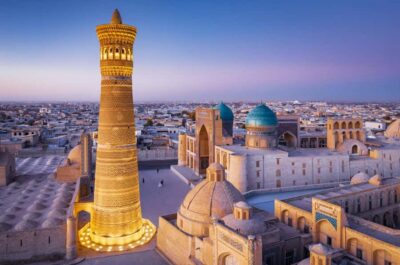
Browse the lists this tour appears in