
Reviewed · 2-DAY EXPERIENCES
Fergana Valley 2-Day Private Tour
Silk Road stories continue east. This two-day private trip takes you beyond the better-known Uzbek cities into the Fergana Valley, where you can see palace art, working pottery studios, ancient ruins, and traditional silk production. I like the small private format, limited to your group of up to three, and I like the chance to meet local craftspeople rather than simply photograph finished souvenirs. The main tradeoff is pace: much of the tour day is spent in the vehicle, and food, entrance fees, and accommodation are not included.
The route begins in Kokand and ends in Margilan, making it useful for a one-way journey through the valley. Guide Sardorbek leads the private tour, with transport included. If you want a broad first look at Fergana Valley culture in only two days, this is an efficient choice, but you should plan your overnight stay and onward travel carefully.
In This Review
- Key points at a glance
- Why the Fergana Valley deserves two days
- Kokand’s Khan Palace and its bold decoration
- Jami Mosque and its 98 columns
- Rishtan pottery, from clay to everyday dishes
- Fergana city and the legacy of Ahmad al-Ferghani
- Kuva’s ruins and the old Silk Road
- Margilan silk and natural dyes
- What the $250 group price really offers
- Timing, comfort, and who should book
- Booking advice before you go
- Should you book the Fergana Valley tour?
- FAQ
- How long is the Fergana Valley private tour?
- How much does the tour cost?
- What is included in the price?
- Are meals included?
- Are entrance tickets included?
- Where does the tour begin?
- Where does the tour finish?
- Who operates the tour?
- Can service animals participate?
- What is the cancellation policy?
Key points at a glance
- Kokand’s Khan Palace: A highly decorated royal residence covered in mosaic and majolica, with about an hour to explore.
- Rishtan pottery: Visit one of Uzbekistan’s best-known ceramic centers and see the craft behind plates, bowls, teacups, and jugs.
- Margilan silk production: Spend two hours with one of the valley’s most important traditional industries, including natural dyeing.
- Private transport for up to three: You avoid a large group and can ask questions as the route unfolds.
- A one-way valley route: Begin at AvgoMoyka Tango in Kokand and finish near the train station in Margilan.
- Good value at $250 per group: For two or three people, the cost becomes much more reasonable than a private tour priced per person.
Why the Fergana Valley deserves two days
Samarkand and Bukhara attract most first-time visitors to Uzbekistan. They deserve the attention, but the Fergana Valley offers a different kind of experience. Here, the focus is less on monumental city centers and more on daily work, regional crafts, agriculture, clothing, food, and local production.
That difference matters. In Kokand, you see the power and taste of a former khanate through architecture. In Rishtan, you see clay shaped into useful household objects. In Margilan, silk is not just a luxury fabric behind glass. It is part of a working tradition involving dye, pattern, and hand production.
I would choose this tour if you want cultural variety in a short time. The route covers five places across two days, so it gives you a useful sense of the region. It does not give you long, unhurried visits in every town. The included sightseeing time totals only a few hours, with the remaining time used for transport.
That makes the private format especially useful. You have your own vehicle and guide rather than joining a fixed large group. You can ask for clarification, spend more time examining a craft, or keep moving when a stop has given you what you need.
More Fergana Valley trips from Uzbekistan:
- Fergana – Golden Valley From Tashkent 1 night / 2 days
★ 4.5 · 41 reviews - Fergana Valley Tour
★ 4.0 · 17 reviews - Fergana One Day Tour From Tashkent
★ 3.4 · 8 reviews
Kokand’s Khan Palace and its bold decoration
The first stop is Kokand’s Khan Palace, also known as the palace of the former rulers of Kokand. You have about one hour to walk through the park and see the palace exterior and decorative work.
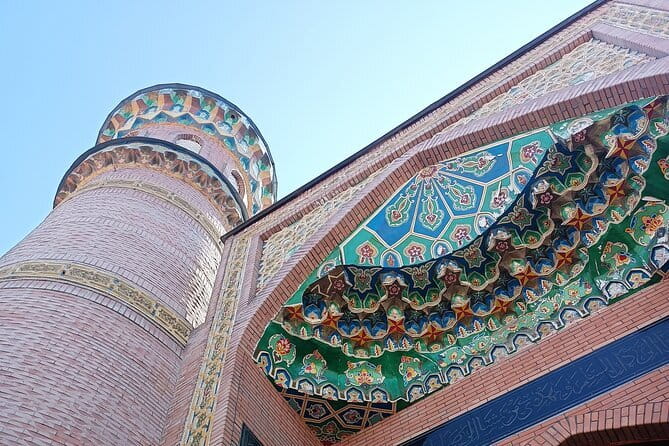
This is not a plain royal residence. The building is covered with mosaic and majolica in many colors, giving it an unusually theatrical appearance. The decoration reflects the skill of local craftsmen and makes the palace feel different from the blue-tiled religious buildings associated with Samarkand.
I would take time to look closely at the repeated patterns, tilework, and color changes rather than rushing through for a single wide photograph. The palace is the sort of place that rewards slow observation, even within a one-hour visit.
Admission is not included, so keep a little cash available for entry. The tour details do not give the exact ticket price, and the fee may change. That small extra cost is worth remembering when you compare the advertised price with your total budget.
Jami Mosque and its 98 columns
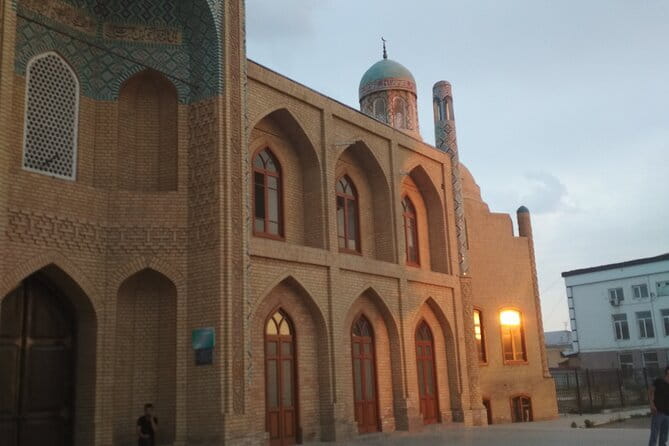
Kokand’s Jami Mosque is next, with about 50 minutes set aside. Built in the 19th century, it sits in the center of the city and is known for its 98 sharply formed columns.
The columns are the main reason to pay attention here. They show how local builders handled a large religious structure while giving it a strong visual rhythm. Instead of seeing only a facade, you get a sense of how the interior is organized around repeated supports.
The stop is shorter than the palace visit, but that is probably enough for a focused look. Again, admission is not included. You should also dress and behave respectfully at a mosque, even though the tour information does not specify a formal dress code.
Together, the palace and mosque give Kokand a useful balance. One shows royal decoration and courtly taste. The other shows religious architecture and practical building skill. If you have only heard of Kokand as another Silk Road stop, these two places explain why the city merits its own visit.
Rishtan pottery, from clay to everyday dishes
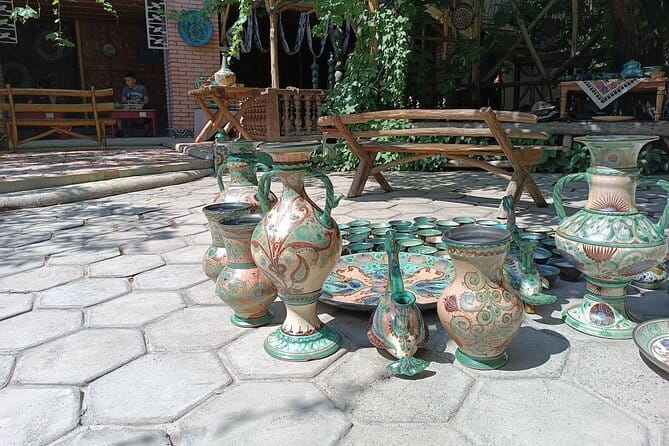
The drive to Rishtan shifts the focus from monuments to making things. Rishtan has been known for pottery production for more than 900 years, and the town remains associated with brightly colored ceramics.
You might see workshops producing lyagans, large dishes used for pilaf, along with soup bowls, tea cups, and kuza jugs. These are not merely decorative objects. They connect the craft to ordinary meals and household use.
That is one of the strongest parts of the tour. A craft visit has more meaning when you understand what the objects are for. A blue ceramic plate is attractive, but it becomes more memorable when you know it may be made for serving pilaf at a family table.
The visit lasts about one hour, and admission is free. The exact workshop arrangements are not specified, so the experience may depend on which local producers are available during your visit. I would ask Sardorbek to explain the process, the designs, and how the pottery is used in the valley.
Rishtan is also the natural place to consider buying ceramics. The tour does not state that purchases are included, so treat shopping as optional and budget separately. If you plan to carry pottery onward, ask about wrapping and transport before buying large pieces.
More two-day trips from Uzbekistan:
- From Bukhara: 2-Day Desert Yurt Camp Tour
★ 4.5 · 57 reviews - 2 Days Tour to Bukhara and Samarkand from Tashkent by train
★ 5.0 · 53 reviews - Yurt stay and Hiking in the Nurata Mountains tour – 2 days
★ 5.0 · 35 reviews - Aral Sea Adventures (2 day)
★ 5.0 · 30 reviews
Fergana city and the legacy of Ahmad al-Ferghani
Day two begins in Fergana, where you spend about 50 minutes. A prominent monument honors Ahmad al-Ferghani, a 9th-century scientist, astronomer, and mathematician associated with the region.
The stop offers a change of mood after Kokand’s palace and Rishtan’s workshops. You are not only seeing architecture and crafts. You are also meeting the intellectual legacy of the valley through one of its celebrated scholars.
The area includes classical Russian-period architecture, which gives the city a different visual character from Kokand. The tour details do not name particular buildings, so your guide’s explanation will matter here. Ask Sardorbek to point out the features that reflect this period and to connect them with the city’s modern center.
Admission is free. The visit is brief, so think of Fergana as an orientation stop rather than a full city tour. It gives you a short introduction to the city’s public spaces, architecture, and connection to Ahmad al-Ferghani before the route continues.
Kuva’s ruins and the old Silk Road
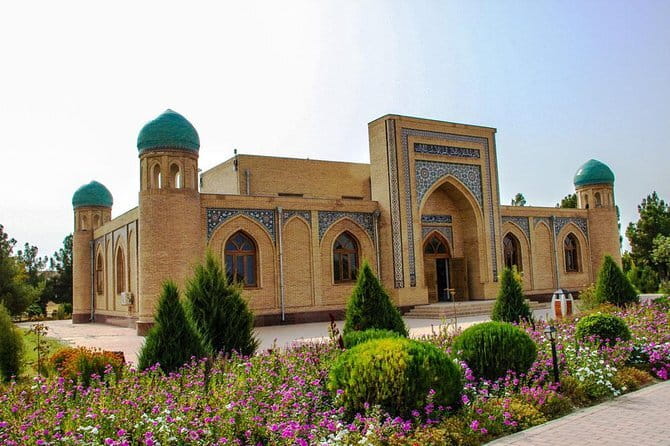
Kuva offers a more archaeological stop. On a hill in the old part of town, a former citadel and shakhristan, the central part of an old city, once occupied the site. Ruins and excavations remain as evidence of Kuva’s importance on the old Silk Road.
The city could not withstand the Mongol invasion, and what remains today is fragmentary. That is part of the appeal, but it also sets the right expectation. You will not find a fully restored urban center or a long sequence of complete buildings.
Instead, you get a place where the shape of the old settlement and the surviving remains help you picture how important Kuva once was. The elevated setting should also help you understand why a citadel was placed there, although the supplied tour details do not promise a specific viewpoint.
The visit lasts about 40 minutes and admission is free. I would treat this as a compact historical stop, best enjoyed with a guide who can explain what you are looking at. Without context, ruins can blur together. With a clear explanation, even a short visit can make the valley’s older trade routes easier to understand.
Margilan silk and natural dyes
Margilan is the final major stop and receives the longest visit, about two hours. Known as a center of natural silk production, the city gives you the clearest look at a living craft tradition on this route.
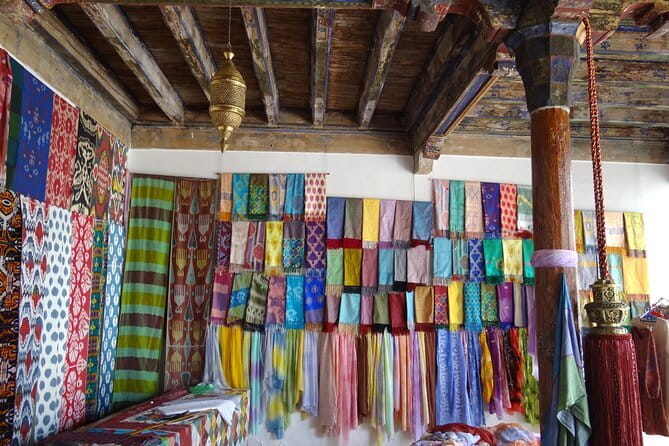
The focus is on fabric dyeing with natural dyes and the continuation of handicraft production. Expect color to be central to the visit, with fabric passing through a process that produces many different shades. The details do not specify which plants or materials are used, so ask your guide or the workshop staff to explain the sources and stages of dyeing.
Two hours is a useful amount of time here. It allows you to look at the fabric, follow the work, and ask questions without treating the stop as a quick shopping break. You can better understand the labor behind a silk textile when you see production rather than only a finished scarf or robe.
The tour does not say that buying silk is required or included. You can enjoy the visit without shopping, but if you do want a piece to take home, compare colors and workmanship carefully. Ask about natural dyes, handmade production, and care instructions before making a purchase.
Margilan gives the tour a strong finish because it brings together art, work, and local identity. The silk is beautiful, but the process is the real point.
What the $250 group price really offers
The price is $250 for a group of up to three people. That is not a per-person rate. For three people, it works out to about $83 per person before meals, entrance tickets, and accommodation. For two people, it is $125 each. For one person, it becomes a costly private excursion.
Transport and a local guide are included. That matters on a two-day route covering several cities and towns, especially when the start and finish points differ. You are paying for a private vehicle, route planning, and someone to interpret the places along the way, not simply for admission to attractions.
You need to add several costs:
- Food
- Entrance tickets at the Khan Palace and Jami Mosque
- Accommodation
- Personal purchases, such as pottery or silk
The tour does not state that hotel pickup is included at every location, but pickup is offered. The listed starting point is AvgoMoyka Tango in Kokand. The end point is near the train station in Margilan, at Uzun xovuz MFY, Shahar Abu Ali Ibni Sino. Confirm the exact pickup details with Sardorbek before the day begins.
The one-way design can improve value if you are already moving through the valley. It is less convenient if you need to return to Kokand or another city immediately after the tour, since the route ends in Margilan.
Timing, comfort, and who should book
The stated duration is approximately two days, but the sightseeing times add up to only about six hours. The rest is transport. That is normal for a route connecting Kokand, Rishtan, Fergana, Kuva, and Margilan, but you should not expect two full days of walking between attractions.
Most people can participate, and service animals are allowed. The tour is near public transportation, and a mobile ticket is provided. No special fitness requirement is listed, though the itinerary includes walking through a palace park and visiting an archaeological site on a hill.
I would recommend this experience to couples, friends, or a small family group that wants flexibility and direct access to a guide. It is also a good fit if crafts matter as much to you as monuments. The pottery and silk stops give the journey a human focus that a standard city sightseeing route may miss.
I would hesitate if you want slow museum visits, long meals, or extensive time in each town. The schedule is broad rather than leisurely. I would also think twice if you are traveling alone on a tight budget, since the $250 group price offers the best value when shared by two or three people.
The tour has a 4.8 rating from four submitted reviews, including strong praise for covering many Fergana Valley sights in two days and for visiting local craft and manufacturing places. The sample feedback specifically highlights the guide and the chance to see local production. That matches the route’s main strength: it connects famous sights with the people and skills behind everyday culture.
Booking advice before you go
Ask for the exact daily departure times, since the sightseeing duration does not include the driving time. Confirm where you will be picked up in Kokand and how the final drop-off near Margilan train station will work.
Plan your overnight accommodation separately. The tour does not include a hotel, and the information provided does not specify where you sleep between the two days. Your lodging should fit the route and the second day’s departure time.
Bring money for palace and mosque admission, meals, and optional purchases. If you are interested in ceramics or silk, leave room in your luggage and ask about safe packing.
Cancellation is generous only if handled early. You can receive a full refund when you cancel at least three full days before the local start time. Cancellations or changes made within three days are not accepted for a refund.
Should you book the Fergana Valley tour?
Book it if you want a private, craft-focused route through several parts of Uzbekistan’s Fergana Valley and you are comfortable spending plenty of time on the road. The combination of Kokand’s decorated palace, Rishtan ceramics, Kuva’s ruins, and Margilan silk gives you a varied picture of the region in a short span.
The strongest value comes when two or three people share the $250 cost. I would choose it for the local production visits and the one-way route, especially if Margilan fits your onward plans. I would skip it if you want a relaxed schedule or need accommodation and meals bundled into one price.
FAQ
How long is the Fergana Valley private tour?
The tour lasts approximately two days. The listed sightseeing time totals several hours, while the remaining time is used for transportation between locations.
How much does the tour cost?
The price is $250 per group of up to three people. It is not listed as a per-person price.
What is included in the price?
A local guide and private transport are included. The tour is private, so only your own group participates.
Are meals included?
No. Food is not included in the tour price.
Are entrance tickets included?
No. Entrance tickets are not included. The Khan Palace and Jami Mosque specifically list admission as excluded, while the Rishtan, Fergana, Kuva, and Margilan stops list free admission.
Where does the tour begin?
The listed starting point is AvgoMoyka Tango, Kokand, in the Fergana Region of Uzbekistan. Pickup is offered, so confirm the exact meeting arrangement before departure.
Where does the tour finish?
The tour ends at Uzun xovuz MFY, Shahar Abu Ali Ibni Sino, in Margilan, near the train station.
Who operates the tour?
The experience provider is Sardorbek.
Can service animals participate?
Yes. Service animals are allowed.
What is the cancellation policy?
You can receive a full refund if you cancel at least three full days before the experience start time. Cancellations and changes made within three full days are not refunded or accepted.
Recently added around Uzbekistan
- Uzbekistan 8 Days Private Guided Tour★ 4.6 · 3 reviews
- Tashkent: 3-Day Horseback Riding Tour in Chimgan Mountains★ 4.4 · 3 reviews
- Samarkand: Uloq-Kopkari (Buzkashi) Game Day Tour★ 5.0 · 3 reviews
- Bird Watching Tours in Samarkand★ 3.6 · 3 reviews
- Bukhara: City Highlights Guided Tour with Pickup★ 5.0 · 3 reviews
- Tashkent Mountain Tour Amirsoy with Transport★ 3.5 · 3 reviews
- 9 Days Private Guided Tour to Uzbekistan★ 5.0 · 3 reviews
- Private Tashkent City Tour★ 5.0 · 3 reviews
2-Day Experiences, compared.
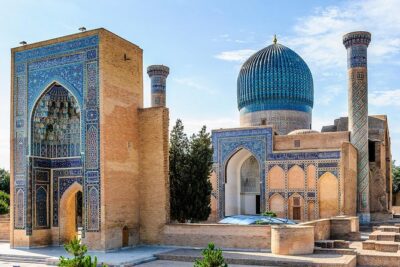
2 Days Tour to Bukhara and Samarkand from Tashkent by train
Read our review →
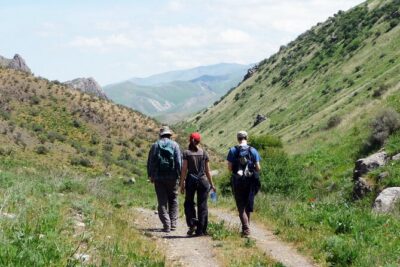
Yurt stay and Hiking in the Nurata Mountains tour – 2 days
Read our review →
Browse the lists this tour appears in