
Reviewed · CITY TOURS
Samarkand: Walking Tour around Old City
Samarkand rewards curious walkers. This $26 small-group tour links the city’s major Timurid monuments in about three and a half hours, with English or Russian guidance from Faridun. I like the strong route, which covers Gur-e-Amir, Registan Square, Bibi-Khanum Mosque, Hazrat Khizr Mosque, and Shah-i-Zinda without wasting time on long transfers. I also like the human angle: the guide explains local traditions and modern life, not just dates carved in stone.
The main consideration is simple: you will walk for most of the tour, and the route can feel demanding in hot weather. Transportation to the meeting point is not included, and the itinerary includes several hours on foot, so comfortable shoes and sensible clothing matter.
In This Review
- Key Details Before You Book
- Starting at Amir Temur’s Equestrian Statue
- Gur-e-Amir and the Timurid Tomb
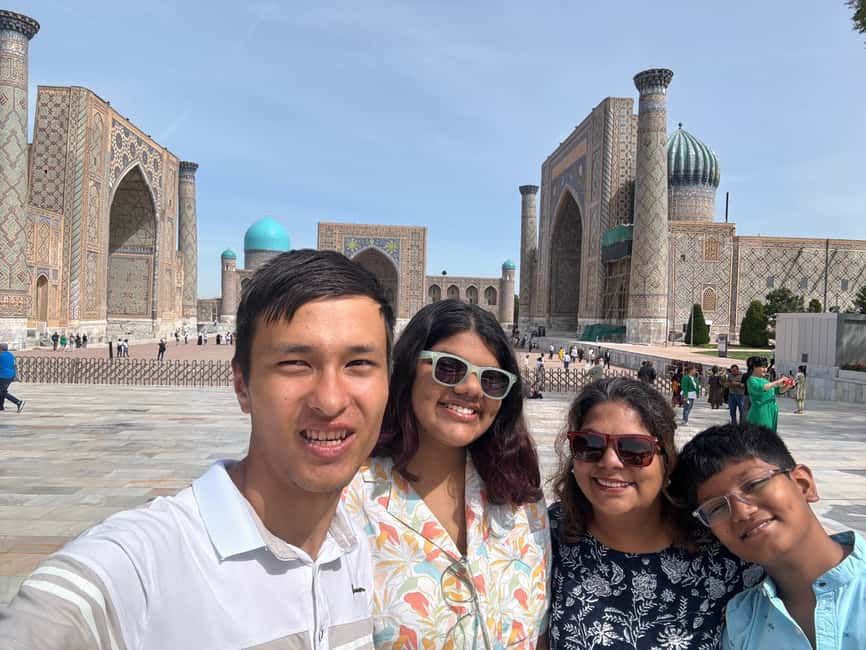
- Registan Square, Samarkand’s Great Stage
- Bibi-Khanum Mosque and a Monumental Love Story
- Hazrat Khizr Mosque Above the Old City
- Shah-i-Zinda, The Living King
- What Faridun Adds to the Walk
- Is $26 Good Value?
- Who Should Book This Samarkand Walk?
- Should You Book It?
- FAQ
- How long does the Samarkand walking tour last?
- Where does the tour begin?
- Which languages are available?
- Who is the guide?
- How many people are in the group?
- Which historic sites are included?
- Is transportation included?
- Are meals included?
- What should I bring?
- Can I cancel for a full refund?
Key Details Before You Book
- Five major sights in one compact route: The walk connects Gur-e-Amir, Registan Square, Bibi-Khanum Mosque, Hazrat Khizr Mosque, and Shah-i-Zinda.
- Faridun is the named guide: He leads in English or Russian and is praised for patient answers, strong historical storytelling, and a friendly manner.
- A small group of up to 10 people: This gives you a better chance to hear explanations and ask questions than you would on a large bus tour.
- A useful introduction to Amir Temur: The tour begins at his equestrian statue, giving you political and historical context before the monuments begin.
- The final stop is Shah-i-Zinda: You finish among blue-tiled mausoleums, with free time to look closely and take photographs.
- Bring cash and a card: Meals are not included, and the tour specifically advises carrying both.
Starting at Amir Temur’s Equestrian Statue
The meeting point is the monument to Amir Temur on University Boulevard Street. Once you reach the boulevard, look for the statue and cross the pedestrian crossing carefully. This is a central, visible starting point, but it is worth arriving with enough time to orient yourself.
The opening stop is more useful than it might first appear. Amir Temur, also known as Tamerlane, founded the Timurid Empire and made Samarkand his capital. At the statue, you hear about his early life, military campaigns, and place in modern Uzbekistan, where he is regarded as a national hero.
The equestrian pose carries its own symbolism, and the surrounding park gives you a quick sense of how the city presents its most famous ruler. You also get a photo stop with greenery and broad views before moving toward the first major monument.
I appreciate this beginning because it gives the rest of the walk a framework. Without it, Samarkand can feel like a parade of beautiful domes. With it, you understand why so much of the city’s monumental building happened under the Timurids and their descendants.
More City Tours in Samarkand
- Samarkand: Historical City Highlights Guided Walking Tour
★ 4.8 · 153 reviews - Private Samarkand City Tour With Transportation
★ 5.0 · 149 reviews - A City Tour Of Samarkand: The Pearl Of The East
★ 5.0 · 133 reviews
Gur-e-Amir and the Timurid Tomb
The walk continues to Gur-e-Amir, the mausoleum of Amir Temur. Plan on about an hour here, including the guide’s explanation and time to look around.
The building is famous for its blue ribbed dome, mosaics, and strong sense of ceremony. Inside, the burial area includes Amir Temur, Ulugh Beg, other sons, and grandsons. The site helps explain that this was not only the tomb of one conqueror. It was a family monument tied to the Timurid ruling line.
Faridun’s storytelling is especially useful at this stop. You hear about Temur’s death and burial in 1405, along with the famous curse associated with opening the tomb. The Soviet excavation in 1941 is another memorable part of the story. These details give the mausoleum a human and political edge, though you should treat the curse as legend rather than established fact.
Gur-e-Amir also sets the visual language for the rest of the tour: colored tile, geometric pattern, monumental scale, and the Timurid love of carefully balanced design. If you enjoy architecture, this is one of the places where the guide’s explanations help you notice details you might otherwise pass by.
The drawback is that the site can be information-heavy. If you prefer a quiet, unstructured visit, you may want to use the guide’s explanation as a starting point, then take a few minutes to look on your own.
Registan Square, Samarkand’s Great Stage
From Gur-e-Amir, the group walks to Registan Square, with about an hour set aside for the visit. This is the visual centerpiece of Samarkand and likely the moment when the scale of the city’s imperial ambition becomes clearest.
Three grand madrasahs frame the square:
- Ulugh Beg Madrasah
- Sher-Dor Madrasah
- Tilla-Kari Madrasah
A madrasah was an Islamic school, and Registan was once a place of education and public life. The square was not built as a decorative backdrop for photographs. It was a working civic and religious center, shaped by teaching, worship, ceremony, and trade.
Ulugh Beg deserves special attention. He was both a ruler and an astronomer, and his interest in science influenced Samarkand’s reputation as a center of learning. The guide connects his role as a scholar with the buildings around you, giving the square more meaning than its famous facade alone.
At Sher-Dor, look for the unusual lion and sun imagery. At Tilla-Kari, the gold-colored interior decoration explains the name, which means decorated with gold. The tilework, symmetry, and astronomical references reward a slow look, especially if Faridun points out patterns that are easy to miss.
You have time here for photographs, souvenir shopping, and exploring inside. That flexibility matters. Registan is one of those places where you need a few quiet minutes to absorb the view after the formal explanation ends.
The square is also the tour’s most likely pinch point. It is visually overwhelming, and an hour can pass quickly. If you are particularly interested in architecture or photography, you may want to return later on your own for more time.
Bibi-Khanum Mosque and a Monumental Love Story
The next walk leads to Bibi-Khanum Mosque, with about 30 minutes for the visit and a photo stop. The mosque was built by Amir Temur for his beloved wife and was once among the largest mosques in the Islamic world.
The romantic story is part of the appeal. You hear about Temur, Bibi-Khanum, and the jealous architect linked to the mosque’s construction. As with many old architectural legends, the story has a dramatic quality that makes the building easier to remember, even when the historical details are less certain.
The physical scale is the real proof of ambition. Massive structures, elaborate surfaces, and large marble Qur’an stands show how much effort went into creating a religious monument fit for an imperial capital. The mosque later fell into ruin, and modern restoration has returned much of its visual force.
Thirty minutes gives you a focused introduction, but not endless time. You can photograph the facade, listen to the explanation, and inspect the main features. If you want long, quiet architectural study, this will feel brief. As part of a route covering five major places, though, the shorter stop keeps the tour moving.
The walking between Registan and Bibi-Khanum is part of the experience. You are not being shuttled from isolated monument to isolated monument. You get a sense of how these sites relate to one another within old Samarkand.
More Walking Tours in Samarkand
- Samarkand: Historical Monuments Guided Walking Tour
★ 4.8 · 446 reviews - Bukhara: Historical City Highlights Guided Walking Tour
★ 4.6 · 102 reviews - Samarkand One Day Tour: one day walking & group tour
★ 4.4 · 87 reviews - Tashkent: Historical City Highlights Guided Walking Tour
★ 4.8 · 71 reviews
Hazrat Khizr Mosque Above the Old City
The route then continues to Hazrat Khizr Mosque, one of Samarkand’s oldest functioning mosques. About 20 minutes are allocated here, including the guided visit and walk.
The mosque is dedicated to Khizr, the immortal saint associated with protection for travelers. That connection gives the stop a fitting place in a walking tour, particularly one built around Samarkand’s old religious and royal center.
The main reward here is the view. From the mosque, you can look across toward Shah-i-Zinda and over the older parts of Samarkand. After the enclosed courtyards and heavy decoration at the earlier monuments, this higher viewpoint provides a welcome change.
The nearby tomb of Islam Karimov, Uzbekistan’s first president, adds a modern political layer to the visit. It is a reminder that Samarkand is not only an archaeological display. The city remains tied to the country’s present identity.
Because the stop is shorter, listen closely when the guide explains the mosque’s role and traditions. Respectful clothing is recommended for mosque visits, and you should be ready to behave quietly and follow any site rules. Photography is allowed at most places on the tour, but the wording matters: not necessarily everywhere or without limits.
Shah-i-Zinda, The Living King
The walk finishes at Shah-i-Zinda, usually written as Shahi-Zinda or Shah-i-Zinda. Allow about 40 minutes, including guided sightseeing and some free time.
The name means The Living King. The complex is a necropolis built and expanded between the 11th and 15th centuries. More than 20 mausoleums line the passage, creating one of Samarkand’s most memorable sequences of blue tile, star-shaped domes, carved surfaces, and narrow architectural views.
The tomb of Qusam ibn Abbas is central to the site’s religious importance. He is described as a cousin of the Prophet Muhammad, and the complex developed around his burial place. The guide also introduces the Timurid princesses and artisans buried here, helping you see the site as a collection of personal memorials rather than one enormous monument.
This is a place where silence matters. You may find yourself paying less attention to a single grand facade and more to the repeated details: tile patterns, small inscriptions, changing shades of blue, and the way the mausoleums appear one after another.
The final free time is welcome. You can take photographs, revisit a detail, or simply walk slowly through the complex. Still, the route involves steps and sustained walking, so the stop may be tiring if you have mobility concerns or are not used to walking in warm conditions.
Ending here is a smart choice. Shah-i-Zinda feels intimate after the broad spectacle of Registan and the vast ambitions of Bibi-Khanum. It leaves you with a quieter impression of Samarkand.
What Faridun Adds to the Walk
The guide can make or break a historical walking tour, and Faridun receives especially strong praise for his approach. He is described as friendly, motivated, patient, and passionate about his work.
The important point is not simply that he knows dates. His explanations are described as detailed and engaging, with comparisons to modern life that help place old events in context. He also answers questions patiently, which matters when you are trying to sort out Amir Temur, Ulugh Beg, the Timurid family, and the many legends attached to their monuments.
One unusual detail is that a Chinese-language review describes a guide named Frank accompanying the group from 9 AM to 3 PM, even though the advertised duration is 3.5 hours. The other feedback names Faridun, and the experience provider is Faridun. I would treat the longer report as a possible extended day rather than something guaranteed. Confirm the expected duration if your schedule is tight.
The group is limited to 10 people. That is small enough for questions and easier listening, though the exact group size on your date can vary up to that limit.
Is $26 Good Value?
At $26 per person, this is a strong-value introduction to Samarkand if you want several major sights explained in one outing. The price includes a live guided tour and visits to the main historical sites, but not meals or transportation to and from the meeting point.
The value comes from the route and the interpretation. You are not paying for a vehicle or a meal package. You are paying for a connected explanation of the city’s monuments, with the benefit of a guide who can explain the people, beliefs, legends, and architectural choices behind them.
The route also helps you use your first day efficiently. Instead of working out how to connect five major sites yourself, you follow a planned walk that begins with Amir Temur and ends at Shah-i-Zinda.
I would still budget for personal expenses. Bring cash and a credit card for souvenirs or other needs, and do not expect food to be supplied during the walk. The practical cost is also physical: your shoes, water needs, and tolerance for several hours of walking will affect how good the value feels.
Who Should Book This Samarkand Walk?
I would recommend it to a first-time visitor who wants a broad introduction to Samarkand and prefers explanations over simply taking photographs. It suits history fans, architecture lovers, and anyone who wants to understand the connection between Amir Temur, the Timurid dynasty, Islamic education, and the city’s major monuments.
It is also a good fit if you prefer a small group and want to ask questions. English and Russian are available, and the repeated praise for Faridun’s patience suggests a guide-led experience rather than a hurried march between photo stops.
You should think twice if you dislike long walks, need frequent breaks, or want to spend an entire morning at one site. The route is packed, and the total time is short relative to the number of major places included. Children under 11 are listed as unsuitable, along with children under 2 through under 10, babies under 1 year, people with diabetes, people with altitude sickness, people over 70, and children under 90 centimeters. These restrictions are unusually broad, so check them carefully before booking.
Wear comfortable clothes and shoes, and choose respectful clothing for the mosques. Drones and pets are not allowed. Photography is permitted at most sites, but follow local instructions.
Should You Book It?
Book this tour if you want the essential Samarkand monuments tied together by a clear story, especially with Faridun as your guide. The best parts are the strong five-site route, the small group, and the lively explanations about Amir Temur, Ulugh Beg, legends, and local traditions.
Skip it if you want a slow architectural study or cannot comfortably walk for several hours. For most first-time visitors, though, $26 is a sensible price for a focused introduction, and the route leaves you knowing where to return for a longer independent visit.
FAQ
How long does the Samarkand walking tour last?
The advertised duration is 3.5 hours. The planned stops add up to roughly three hours and 40 minutes of sightseeing and walking time, so allow some flexibility.
Where does the tour begin?
It begins at the Amir Temur monument on University Boulevard Street in Samarkand. Look for the statue and cross the pedestrian crossing carefully.
Which languages are available?
The live guide is available in English and Russian.
Who is the guide?
The named guide and experience provider is Faridun.
How many people are in the group?
The tour is described as a small-group experience limited to 10 participants.
Which historic sites are included?
The tour includes the Amir Temur monument, Gur-e-Amir Mausoleum, Registan Square, Bibi-Khanum Mosque, Hazrat Khizr Mosque, and Shah-i-Zinda ensemble.
Is transportation included?
Transportation to and from the meeting point is not included. The experience itself is a walking tour.
Are meals included?
No. Meals are not included.
What should I bring?
Bring comfortable shoes, comfortable clothing, cash, and a credit card.
Can I cancel for a full refund?
Yes. You can cancel up to 24 hours in advance for a full refund. You can also reserve now and pay later.
Recently added around Samarkand
- Bird Watching Tours in Samarkand★ 3.6 · 3 reviews
- Penjikent Day Trip From Samarkand★ 5.0 · 3 reviews
- Samarkand: city tour★ 4.7 · 3 reviews
- Samarkand Capital of Amir Timur Private Tour with Transport★ 5.0 · 3 reviews
- Seven Lakes Panjakent: One-Day Adventure from Samarkand★ 5.0 · 3 reviews
- Ancient and Modern tour in Samarkand with Transport★ 5.0 · 3 reviews
- Samarkand: Cooking class with local family★ 5.0 · 3 reviews
- Amankutan Trek One Day Tour From Samarkand★ 3.9 · 3 reviews
City Tours, compared.
Private Samarkand City Tour With Transportation
Read our review →
A City Tour Of Samarkand: The Pearl Of The East
Read our review →
Browse the lists this tour appears in