
Reviewed · EVENING EXPERIENCES
A Night In The Kyzylkum Desert [2] From Khiva
The desert night is the real prize. This private two-day trip links the Aral Sea’s ship cemetery, Nukus’s remarkable Savitsky Museum, Karakalpak culture, and seven ancient fortresses near the Kyzylkum Desert. I especially like the mix of modern tragedy and old Khorezm archaeology, plus the chance to sleep in a yurt beside Ayaz-Kala.
I also like that the price is $499 per group of up to three, not per person, and includes private transport, an air-conditioned vehicle, pickup, and drop-off. The main drawback is the pace: Muynak, Nukus, and a long chain of remote ruins make this a demanding two days, with museum and yurt costs added separately.
In This Review
- Key points before you book
- Why this route is different from a normal Khiva excursion
- Chilpiq Qala and the first look at ancient Khorezm
- Nukus and the Savitsky Museum
- Muynak’s museum and the dry Aral Sea
- Muynak’s ship cemetery: a powerful, uneasy stop
- The yurt night beside Ayaz-Kala
- Ayaz-Kala: the fortress with the desert view
- Toprak-Kala and the royal side of Khorezm
- Four more fortresses, four different impressions
- The final Khorezm stop and return toward Khiva
- What the $499 group price really covers
- Who should book this desert journey?
- FAQ
- Where does the tour start?
- Can I be picked up in Khiva?
- Where can I be dropped off?
- How long does the tour last?
- How many people can join the private tour?
- Is transportation included?
- Is a guide provided?
- Is the yurt night included in the price?
- Are museum and fortress tickets included?
- What is the minimum age?
- Can I cancel for a full refund?
- Should you book it?
Key points before you book
![A Night In The Kyzylkum Desert [2] From Khiva - Key points before you book](https://9.theuzbekistanguide.com/wp-content/uploads/a-night-in-the-kyzylkum-desert-2-from-khiva-1.jpg)
- The Aral Sea story is stark: Muynak’s ship cemetery and regional museum show the human and environmental cost of the sea’s disappearance.
- The Savitsky Museum adds real depth: Its collection of Russian and Central Asian art is far more important than its remote location suggests.
- Seven fortresses fill the second day: Ayaz-Kala, Toprak-Kala, Guldursun Qala, Kyzyl Kala, Koi Krylgan Kala, Angka Kala, and a final Khorezm site create an unusually broad archaeological route.
- The yurt night costs extra: Accommodation with dinner and breakfast is listed at $50 per day.
- This is a private trip: Only your own group participates, making the long drive easier to manage.
- You need moderate fitness: Expect open sites, rougher ground, heat, and plenty of walking around ruins.
Why this route is different from a normal Khiva excursion
![A Night In The Kyzylkum Desert [2] From Khiva - Why this route is different from a normal Khiva excursion](https://9.theuzbekistanguide.com/wp-content/uploads/a-night-in-the-kyzylkum-desert-2-from-khiva-2.jpg)
Khiva is famous for its preserved walled old town, but this trip takes you well beyond its polished monuments. You cross into Karakalpakstan, a distinct region with its own traditions, desert settlements, archaeological sites, and painful connection to the Aral Sea disaster.
That contrast gives the journey its purpose. One moment you are looking at a Zoroastrian funerary tower. Later, you are standing beside rusting ships stranded on dry ground. Then you sleep in a yurt near a fortress that once guarded the edge of ancient Khorezm.
You are not simply collecting photo stops. You are seeing how people adapted to a difficult environment over more than two thousand years, and how modern decisions changed that environment in a single lifetime.
The trip begins at 8:00 a.m. Pickup is available from Khiva or Nukus. Since the vehicle is private, you can travel with your own group rather than joining strangers. That matters here because the route covers large distances and the days are tightly packed.
More evening trips in Khiva:
- From Khiva To Aral Sea 2-Days One Night In Yurt Stay
★ 4.6 · 20 reviews - Tashkent : Classic City Tour. (Day & Night Shift)
★ 4.8 · 52 reviews - Fergana – Golden Valley From Tashkent 1 night / 2 days
★ 4.5 · 41 reviews
Chilpiq Qala and the first look at ancient Khorezm
The first listed stop is Chilpiq, also called Shilpiq or Chilpak Kala. This round, roofless Zoroastrian dakhma is more than 2,200 years old. It rises about 15 meters high and measures roughly 65 meters across, sitting on top of a rocky rise.
A dakhma was connected with Zoroastrian funerary practice. Its open design is a sharp contrast to the enclosed fortresses later in the journey. You get about 30 minutes here, enough to look around and take in the setting, but not enough for a slow archaeological study.
Admission is not included, so keep a little cash available for site fees. The practical challenge is exposure. There is no promise of shade, and the surrounding desert terrain can make even a short stop feel strenuous in hot weather.
Still, Chilpiq is a strong opening. It gives you an early reminder that the Khorezm region was not just a medieval Muslim kingdom. Several faiths, dynasties, and cultures passed through this corridor long before modern Uzbekistan existed.
Nukus and the Savitsky Museum
Nukus is the capital of Karakalpakstan and the home of the State Museum of Art named after I.V. Savitsky. The museum is allotted one hour, with admission listed separately at $10.
This is one of the most valuable stops on the route because it changes the tone of the trip. After archaeological ruins and long desert roads, you get a concentrated look at art gathered in one of Central Asia’s most remote cities.
The collection is associated with Igor Savitsky, whose work helped preserve art that might otherwise have been lost or ignored. The museum’s location is part of its appeal. You are seeing an important cultural institution in a place many people would not expect to find it.
One hour is useful but limited. If art is a major interest for you, you may wish the schedule allowed more time. The audio guide can help provide context, but the included service is described as an audio guide with a driver, not a dedicated art historian. That distinction matters if you want detailed discussion of individual works.
Muynak’s museum and the dry Aral Sea
![A Night In The Kyzylkum Desert [2] From Khiva - Muynak’s museum and the dry Aral Sea](https://9.theuzbekistanguide.com/wp-content/uploads/a-night-in-the-kyzylkum-desert-2-from-khiva-4.jpg)
The road continues to Muynak, once a port on the Aral Sea. The Muynak Regional Studies Museum, also called the Ecological Museum of Muynak, receives about 30 minutes in the schedule. Admission is listed at $7.
This stop works best when you understand what Muynak represents. The Aral Sea was once the fourth-largest inland sea in the world. Its disappearance, caused by large-scale water diversion, changed local work, health, settlement patterns, and the surrounding environment.
The museum is modest rather than grand. That is part of the point. You are not entering a major national institution with polished displays at every turn. You are seeing a local record of a regional crisis.
Thirty minutes will give you a useful introduction, but you should not expect an exhaustive museum visit. The strongest value comes from pairing the museum with the next stop, the ship cemetery.
A few more Khiva trips worth weighing up
- Khiva: Historical City Highlights Guided Walking Tour
★ 4.8 · 156 reviews - Transfer: Bukhara – Khiva via Ancient Fortresses
★ 4.5 · 101 reviews - Daytrip From Khiva To Ancient Fortresses
★ 4.6 · 60 reviews - Ayazkala, Toprakkala & Kizilkala Fortress Tour From Khiva
★ 4.3 · 33 reviews
Muynak’s ship cemetery: a powerful, uneasy stop
![A Night In The Kyzylkum Desert [2] From Khiva - Muynak’s ship cemetery: a powerful, uneasy stop](https://9.theuzbekistanguide.com/wp-content/uploads/a-night-in-the-kyzylkum-desert-2-from-khiva-5.jpg)
The ship cemetery is free to visit and also limited to about 30 minutes. Rusting vessels sit on land where water once reached, creating one of the most memorable scenes in northern Uzbekistan.
It is an easy place to take photographs, but the scene should not be treated as a novelty alone. The ships are physical evidence of a vanished working life. They point to fishing, transport, and a port community that lost its sea.
I like that the tour places the museum and cemetery together. The museum gives you background, while the ships make the loss visible. You can understand the Aral Sea disaster in statistics, but the stranded hulls communicate it more directly.
The drawback is the amount of driving required to reach Muynak and return toward the desert fortresses. This is not a quick side trip from Khiva. If you dislike long road days, this experience may feel exhausting. If the Aral Sea is one of your main reasons for visiting Uzbekistan, the distance is likely worth accepting.
The yurt night beside Ayaz-Kala
![A Night In The Kyzylkum Desert [2] From Khiva - The yurt night beside Ayaz-Kala](https://9.theuzbekistanguide.com/wp-content/uploads/a-night-in-the-kyzylkum-desert-2-from-khiva-6.jpg)
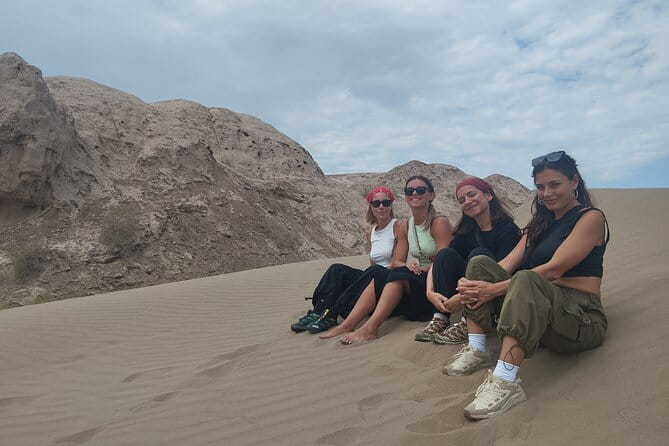
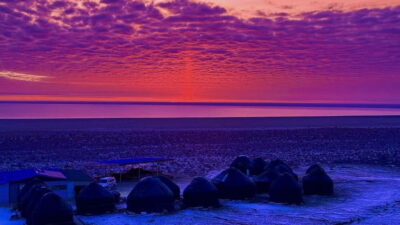
The overnight stay is the emotional center of the trip. Accommodation is in a yurt in the Kyzylkum Desert near Ayaz-Kala, with dinner and breakfast listed as an additional $50 per day.
This is not a luxury hotel substitute, and you should approach it as a simple cultural stay. The appeal is the setting: open desert, traditional nomadic connections, camels nearby, and a night sky far from city lights.
The experience also offers contact with local desert life. Camels may walk around the camp, and camel milk can be tasted from local families. That detail gives the overnight stop more substance than simply sleeping in an unusual building.
The star-filled sky is another major reason to stay. Away from the lights of Khiva, the desert can offer a much clearer view of the night sky. No special performance is needed. The quiet and darkness do the work.
The extra fee is reasonable to consider within the full budget, but remember that it is not included in the $499 tour price. Dinner and breakfast are included with the listed yurt accommodation, while museum and fortress admission fees are separate.
Ayaz-Kala: the fortress with the desert view
![A Night In The Kyzylkum Desert [2] From Khiva - Ayaz-Kala: the fortress with the desert view](https://9.theuzbekistanguide.com/wp-content/uploads/a-night-in-the-kyzylkum-desert-2-from-khiva-7.jpg)
Day two begins with Ayaz-Kala, a group of fortifications dating from the 4th century BCE through the 7th century CE. The site sits on a hill overlooking the Kyzylkum Desert, and about one hour is allowed here.
This is likely to be the most rewarding fortress stop because of its position. You do not just inspect walls. You look across a broad, dry expanse and see why high ground mattered to the communities that built and maintained these strongholds.
The free admission listed for Ayaz-Kala keeps the cost down, though other fortress fees are estimated at around $2. Since the ruins are open-air sites, your comfort depends on weather, footwear, water, and sun protection.
Ayaz-Kala also gives you the clearest connection between the yurt night and the archaeology. You wake near the desert, then spend the morning among fortifications that once controlled this same difficult environment.
Toprak-Kala and the royal side of Khorezm
![A Night In The Kyzylkum Desert [2] From Khiva - Toprak-Kala and the royal side of Khorezm](https://9.theuzbekistanguide.com/wp-content/uploads/a-night-in-the-kyzylkum-desert-2-from-khiva-8.jpg)
Toprak-Kala dates from the Kushan period, around the 2nd and 3rd centuries CE. It served as a royal residence of the kings of Khorezm and earlier functioned as a royal sanctuary. The visit lasts about 30 minutes, and admission is not included.
Compared with a simple defensive outpost, Toprak-Kala helps you picture government, ceremony, and court life. Its remains are not a complete palace, but the scale and purpose point to a more organized center of power.
Half an hour is enough for a focused visit, especially after Ayaz-Kala, but you will not have time to inspect every feature slowly. The value here comes from the sequence: first a fortress with a broad desert outlook, then a site linked to rulers and royal life.
Four more fortresses, four different impressions
The rest of the day moves quickly. Each site gets roughly 30 minutes, so you should think of this as a broad survey rather than a detailed archaeological study.
Guldursun Qala is a fortified town with exterior walls and towers dating to the 12th century. Excavations have found pottery, bronze objects, and coins. Admission is free. It gives you a medieval layer of the region, later than the Kushan-era Toprak-Kala.
Kyzyl Kala was first built between the 1st and 4th centuries CE, then abandoned and rebuilt in the 12th or 13th century before the Mongol invasions. The site has a complicated building history, which makes it especially useful for seeing how fortresses were reused. Admission is not included.
Koi Krylgan Kala lies outside Taza-Kel’timinar village in the Ellikqala District. Its unusual name and remote setting make it another distinct stop, though 30 minutes will keep the visit brisk. Admission is free.
Angka Kala is dated to the 1st through 3rd centuries and again to the 10th through 12th centuries. It sits about 22 kilometers north of Turtkul and has an almost square plan with well-preserved features. Admission is free.
Taken together, these sites show that the desert was not empty. It held settlements, routes, defensive systems, religious buildings, and political centers. The repeated stops can blur together if you are not interested in archaeology, so the audio guide becomes useful. You should also take notes or photographs of signs if you want to remember which walls belong to which fortress.
The final Khorezm stop and return toward Khiva
The itinerary ends with a 20-minute stop at Itchan Kala, described in the details as Duman Kala, a complex with several adjacent sections, corner towers, a citadel, and a northern enclosure.
The naming here may be confusing because Itchan Kala is also the famous walled old town of Khiva. Ask the driver to confirm exactly which site you are visiting on the day. That small clarification can prevent confusion, especially after a long route through several similarly named archaeological places.
The stop is short, so do not expect a full Khiva old-town visit within this tour. Drop-off is available in Khiva or Urgench, which is useful if you are continuing onward from the area.
What the $499 group price really covers
At $499 for up to three people, the base price works out to about $166 per person for a full private two-day route if your group has three members. For two people, it is about $250 each. A solo participant pays the full group price, so this arrangement makes the most financial sense for a small party.
The included private vehicle, air conditioning, pickup, and drop-off are important here. You are covering remote sites across a large area, and arranging separate transport would be complicated. The driver takes you to the locations, and an audio guide is provided.
Budget separately for:
- Yurt accommodation, dinner, and breakfast: $50 per day
- Savitsky Museum: $10
- Muynak Museum: $7
- Fortress admission: around $2 where charged
The real value is not the number of stops alone. It is the combination of transport, access to remote places, and a private schedule. The price is less attractive for one person, but quite sensible for three people sharing the vehicle.
Who should book this desert journey?
I would recommend it to you if you want more than Khiva’s old town and are willing to spend long hours on the road. It suits people interested in archaeology, Soviet-era environmental history, Central Asian cultures, photography, and simple overnight stays.
Families can consider it too, since the youngest stated age is seven. Still, moderate physical fitness is required, and the schedule may be tiring for younger children. The open sites and heat also call for patience.
I would hesitate if you want a relaxed holiday with short transfers, long museum visits, or hotel comfort every night. This is a packed route. The seven-fortress day gives you breadth, not leisurely inspection.
The private format helps. You can pause briefly, ask for clarification, and manage your own group’s rhythm more easily than on a large coach tour. But the driver is not described as a live specialist guide, so travelers seeking detailed historical interpretation should keep expectations realistic.
FAQ
Where does the tour start?
The tour starts at 8:00 a.m.
Can I be picked up in Khiva?
Yes. Pickup is offered from Khiva or Nukus.
Where can I be dropped off?
Drop-off is available in Khiva or Urgench.
How long does the tour last?
The experience lasts approximately two days.
How many people can join the private tour?
The price covers one private group of up to three people.
Is transportation included?
Yes. Private transportation and an air-conditioned vehicle are included.
Is a guide provided?
An audio guide is provided, and the driver takes you to the locations.
Is the yurt night included in the price?
No. Yurt accommodation with dinner and breakfast costs an additional $50 per day.
Are museum and fortress tickets included?
No. The Savitsky Museum is listed at $10, the Muynak Museum at $7, and fortress admission is around $2 where charged.
What is the minimum age?
The youngest age accepted is seven years old.
Can I cancel for a full refund?
Yes, if you cancel at least 24 hours before the experience begins. Cancellations within 24 hours are not refunded.
Should you book it?
Book this trip if the Aral Sea, desert fortresses, and a yurt night all appeal to you. The combination is unusual, and the private format makes a hard-driving route more manageable. I would especially choose it for a group of three, when the base cost becomes much better value.
Skip it if you want a gentle schedule or dislike remote ruins. For the right person, though, this is a memorable extension from Khiva: a clear look at Karakalpak life, a sobering encounter with Muynak, and a night under desert stars beside the remains of ancient Khorezm.
Recently added around Khiva
- Khorezm Fortress and KyzylKum Desert Private Tour★ 5.0 · 3 reviews
- Best of Khiva: Exclusive Private Tour!★ 5.0 · 3 reviews
- Khiva: City Highlights Guided Walking Tour★ 4.6 · 3 reviews
- Khiva: classic Half-Day Tour★ 3.7 · 3 reviews
- Master Class – Uzbek Bread (Khiva)★ 3.5 · 4 reviews
- Uzbekistan 6 Days Private Tour Khiva-Bukhara-Samarkand by Train★ 5.0 · 4 reviews
- Traditional Khiva Cooking Class with Market Visit & Lunch★ 5.0 · 4 reviews
- Aral Sea – Extended trip (3 days)★ 5.0 · 5 reviews
Evening Experiences, compared.
Life As Nomads – Yurt Camp Tour with Night from Samarkand
Read our review →
Browse the lists this tour appears in