
Reviewed · KHIVA TOURS
Khiva: classic Half-Day Tour
Khiva rewards slow walking. This half-day tour gives you a clear introduction to Itchan Kala, the ancient walled center of Khiva, with stops at the Kunya Ark Citadel, Mukhammad Rakhim Khan Madrasah, Kalta Minaret, and Tosh Khovli Palace. I like the compact route and the chance to hear the story behind each building instead of simply photographing blue tiles. I also like that hotel pickup and drop-off are included, which keeps a short visit easy to manage.
The main caution is price clarity. At $45 per person, the tour can be fair value if your guide explains the sites well and admission charges remain reasonable, but tickets are not included. One booking account also described paying far more than another couple on a similar walking tour, so I would confirm the total cost and exact inclusions before you pay.
The pace should suit anyone who wants Khiva’s major sights in four to five hours. Still, this is a walking tour over historic surfaces, with limited suitability for people using wheelchairs or managing mobility problems. Wear good shoes, carry water, and bring a hat. Khiva’s sun is not shy.
In This Review
- Key points at a glance
- Why this Khiva walk works well in four hours
- Entering Itchan Kala, Khiva’s walled old city
- Kunya Ark Citadel and the machinery of royal power
- Mukhammad Rakhim Khan Madrasah and Islamic education
- Kalta Minaret, Khiva’s unfinished landmark
- Tosh Khovli Palace, the Stone House
- What the guide adds to the experience
- Is $45 per person good value?
- Timing, clothing, and practical comfort
- Who should book this Khiva experience?
- Should you book the classic half-day tour?
- FAQ
- How long does the Khiva classic tour last?
- What places are visited?
- Is hotel pickup included?
- Are entrance tickets included in the price?
- What languages are available?
- Is this a private tour?
- What should I bring?
Key points at a glance
- Itchan Kala first: Begin inside Khiva’s UNESCO-listed walled city, where the main sights are close enough to reach on foot.
- Four major monuments: See the Kunya Ark Citadel, Mukhammad Rakhim Khan Madrasah, Kalta Minaret, and Tosh Khovli Palace.
- A useful first orientation: The route covers royal power, Islamic education, religious architecture, and palace life in one morning or afternoon.
- English, Russian, or Uzbek: A live guide is available in these languages, with private groups offered.
- Tickets cost extra: The $45 rate includes guiding, taxes, and hotel transfers, but not admission fees.
- Best for able walkers: Comfortable shoes, sun protection, and water are essential, and flash photography is not allowed indoors.
Why this Khiva walk works well in four hours
Khiva is an unusually manageable historic city. Its old center, Itchan Kala, is enclosed by walls and packed with monuments, mosques, madrasahs, palaces, and narrow lanes. You do not spend half the tour stuck in traffic. Instead, the experience is built around walking from one important building to the next.
That makes this a sensible first activity in Khiva. You get the basic map of the old city, learn how the khanate was governed, and begin to understand how religion, royal authority, trade, and education shaped Khorezm. The route is not just a parade of façades. Each stop covers a different part of the city’s past.
The planned visits take about 40 minutes in Itchan Kala, 20 minutes at Kunya Ark, 20 minutes at the Mukhammad Rakhim Khan Madrasah, 20 minutes at Kalta Minaret, and 30 minutes at Tosh Khovli Palace. Add time for walking, questions, and possible ticket arrangements, and the advertised four to five hours makes sense.
You should not expect every corner of Khiva in one half-day. The appeal is focus. You see the famous core without trying to cram every monument into one tiring march.
More half-day trips in Khiva:
- Half-day excursion around Tashkent
★ 5.0 · 3 reviews
Entering Itchan Kala, Khiva’s walled old city
The tour begins with Itchan Kala, the historic center of Khiva. This fortified inner city is one of Uzbekistan’s key cultural sites and one of the best-preserved examples of a Central Asian walled town.
Your first few minutes here matter. The guide can give you a sense of how the city fits together before individual monuments begin competing for your attention. Look at the relationship between the walls, towers, lanes, and monumental buildings. Khiva feels less like a collection of isolated attractions and more like a complete historic district.
The 40-minute introduction includes walking, sightseeing, and time for photographs. That is enough for orientation, though not enough for every detail. If a particular gate, tile pattern, or street catches your eye, ask about it. A live guide in English, Russian, or Uzbek gives you a much better chance of connecting the architecture with the people who used it.
The practical issue is the ground beneath your feet. Walking through an old walled city can mean uneven surfaces and repeated standing. This activity is not suitable for wheelchair users or people with mobility impairments, so consider that honestly before booking.
Kunya Ark Citadel and the machinery of royal power
Kunya Ark is the old citadel of Khiva. It was first built around 1647 by Arang Khan and served as a royal residence and administrative center for the khans who ruled the Khorezm region.
That function gives the citadel its weight. You are not simply looking at an old fortified building. You are entering the place where rulers lived, made decisions, and managed the affairs of the khanate. A good explanation here should help you picture the citadel as a working center of government, not just a set of restored walls.
The scheduled visit is about 20 minutes, so expect a concise introduction rather than a full archaeological study. You may want to ask your guide which rooms or sections best show the citadel’s role. The short stop is useful because it leaves time for the other major monuments, but it can feel brisk if you are fascinated by royal architecture.
I would treat Kunya Ark as the political chapter of the walk. Later, the madrasah explains religious education, and Tosh Khovli shows palace life. That sequence gives the tour a natural shape.
Mukhammad Rakhim Khan Madrasah and Islamic education
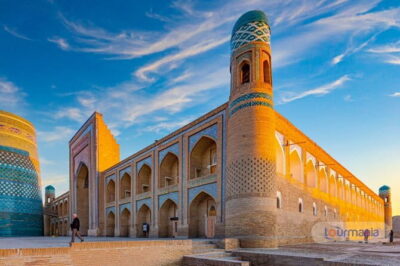
The Mukhammad Rakhim Khan Madrasah dates from about 1876, during the reign of Muhammad Rakhim Khan II. It forms part of Khiva’s wider architectural ensemble, which has UNESCO World Heritage status.
A madrasah was more than a decorative courtyard with students passing through. It was tied to Islamic learning and the intellectual life of the city. Your guide can explain how the building fit into Khiva’s religious and cultural system, helping you see the madrasah as an institution rather than a photogenic stop.
The visit lasts around 20 minutes. That is enough to take in the proportions, decoration, and historical role, but you will need to keep moving. If you care about Islamic architecture, ask for details about the layout and the building’s educational purpose.
This is one of the places where a guide earns the fee. Without context, a madrasah can blur into the next tiled monument. With context, you begin to see how Khiva developed as a center of faith, scholarship, and government.
A few more Khiva trips worth weighing up
- Khiva: Historical City Highlights Guided Walking Tour
★ 4.8 · 156 reviews - Transfer: Bukhara – Khiva via Ancient Fortresses
★ 4.5 · 101 reviews - Daytrip From Khiva To Ancient Fortresses
★ 4.6 · 60 reviews - Ayazkala, Toprakkala & Kizilkala Fortress Tour From Khiva
★ 4.3 · 33 reviews
Kalta Minaret, Khiva’s unfinished landmark
The Kalta Minaret is one of Khiva’s most recognizable sights. Its unusual shape and unfinished construction make it easy to identify, even among the many decorated buildings of Itchan Kala.
The minaret is a good reminder that historic cities contain unfinished plans as well as completed monuments. Its incomplete state is not a flaw to overlook. It is the central part of the story and gives your guide something specific to explain about Khiva’s architectural ambitions and political past.
The stop includes about 20 minutes for a visit, guided explanation, and photography. Since the minaret is an exterior landmark, this is likely one of the easier places to pause and get your camera ready. Flash photography is not permitted inside buildings, but ordinary photography is allowed.
Do not rush this stop just because it is familiar from photographs. Notice how the minaret relates to the surrounding madrasah and lanes. Khiva’s architecture works best when you look at buildings together, not as separate postcard objects.
Tosh Khovli Palace, the Stone House
Tosh Khovli Palace, also written Tash Khauli, was built between 1830 and 1838 during the reign of Allakulikhan. Its Uzbek name means Stone House, a reference to its solid brick construction.
The palace gives the tour a more personal and domestic angle. Kunya Ark represents the seat of power, while Tosh Khovli helps you think about how that power was housed and displayed. The building belongs to the world of the khan’s court, with architecture designed to express status, order, and permanence.
You have about 30 minutes here, making it the longest individual monument stop after the opening walk through Itchan Kala. That extra time is welcome. Palaces often need more explanation than a single exterior view can provide, and you will want time to look at decorative details without feeling pushed through.
I would save a few questions for Tosh Khovli. Ask how the palace differed from Kunya Ark, what its name tells you about the building materials, and how it fitted into the changing culture of the Khiva Khanate. The tour description specifically presents Khiva through its Islamic heritage and cultural evolution, and this palace helps broaden that picture beyond religious buildings.
What the guide adds to the experience
A guide can make this route much more than a walk between famous names. The monuments cover several centuries and different roles, so dates alone will not hold the story together. You want explanations that connect Arang Khan’s citadel, Muhammad Rakhim Khan II’s madrasah, the unfinished Kalta Minaret, and Allakulikhan’s palace.
The available guide languages are English, Russian, and Uzbek. A private group is also available, which may be worth considering if you want to stop for questions or set a slower pace. The information supplied does not promise a specific maximum group size, so confirm that detail if it affects your decision.
The guide’s actual performance matters more than the route on paper. One booking account praised the guide for being professional, flexible, personable, and committed to the client, but that account described a different excursion to ancient fortresses, including a long drive into Karakalpakstan. I would not use that praise as a guarantee for this city walk. Instead, treat it as a reminder to confirm which guide and which exact experience you are booking.
Is $45 per person good value?
The price is $45 per person. For that fee, you receive hotel pickup and drop-off in Khiva, a professional guide, and taxes. Admission tickets are extra, which changes the real cost and deserves attention before you commit.
The value is strongest if you have only a short time in Khiva or want a clear introduction before exploring independently. A guide can save you from wandering past the same building without understanding its purpose. Hotel transfers also help if you are staying outside the immediate old city or prefer not to sort out the starting point yourself.
The value is weaker if you already know the monuments, have strong historical background, or are comfortable arranging a simple walk on your own. Itchan Kala is compact, and many sights can be reached without transport. In that case, you are paying mainly for interpretation, structure, and convenience.
There is also a notable price warning. A booking account reported paying €101 for a couple on this classic tour, while another couple on a walking tour paid €49. That may reflect different products, dates, or inclusions, but the gap is large enough to justify a direct question. Confirm the per-person rate, admission fees, private-group status, and whether the advertised hotel transfer applies to your accommodation.
Timing, clothing, and practical comfort
The tour lasts four to five hours, with starting times dependent on availability. Since you walk between all the principal sites, choose a time that fits the weather and your energy. The provided guidance specifically asks you to prepare for changing conditions, bring water, wear sunscreen, and use a hat.
Comfortable shoes are not optional here. Even a short historic walk becomes unpleasant when you are standing on uneven surfaces in poor footwear. Carry a camera if photography matters to you, but remember that flash photography is prohibited inside the buildings.
Smoking is not allowed, and neither is eating or drinking during the tour. Water is still specifically recommended for hydration, so bring it for sensible use during the walk. If you need a meal, plan it before or after the activity rather than expecting to eat along the route.
Pickup details are provided the day before the tour. Keep an eye out for that information and make sure the meeting point is clear. Hotel pickup and drop-off are included, but the exact arrangements depend on the details sent for your booking.
Who should book this Khiva experience?
I would recommend this tour to a first-time visitor who wants the main monuments explained in a logical order. It is also a good fit if you have just half a day, prefer walking to vehicle sightseeing, or want help understanding the connection between royal authority, Islamic learning, and palace culture.
It suits visitors who enjoy architecture but do not want to spend hours reading plaques. The four principal stops give you a strong starting point, and you can return later to whichever building interests you most.
I would be more cautious if you need step-free access, tire quickly while walking, or want a slow photography-focused outing. The route is designed to cover several sites, not to linger at one monument for a long time. I would also compare the cost carefully if you are traveling as a couple or group, since the final price can change once extra tickets and product differences are included.
Free cancellation up to 24 hours before the start and a reserve-now, pay-later option make planning less risky. Those terms are useful, but they do not replace checking the exact price and admission arrangements.
Should you book the classic half-day tour?
Book it if you want a well-organized introduction to Khiva’s central monuments, especially with limited time. The route is sensible, the sites are important, and the guide can turn a pleasant walk through Itchan Kala into a readable story about the Khorezm region.
Before paying, confirm the total cost, the entrance-ticket charges, the language of your guide, and whether you are receiving a private group. If those details are clear and the $45 price remains accurate, this is a practical way to get your bearings fast and see Khiva’s essential sights without wasting a morning finding each one yourself.
FAQ
How long does the Khiva classic tour last?
The tour lasts approximately four to five hours, depending on the available starting time and the pace of the walk.
What places are visited?
The tour visits Itchan Kala, the Kunya Ark Citadel, the Mukhammad Rakhim Khan Madrasah, the Kalta Minaret, and Tosh Khovli Palace.
Is hotel pickup included?
Yes. Hotel pickup and drop-off in Khiva are included. Exact pickup information is provided the day before the tour.
Are entrance tickets included in the price?
No. Admission tickets are not included, so you should confirm the additional cost before booking.
What languages are available?
Live guiding is available in English, Russian, and Uzbek.
Is this a private tour?
A private group option is available. Confirm the group arrangement when booking if privacy or a flexible pace is important to you.
What should I bring?
Bring comfortable walking shoes, a hat, a camera, sunscreen, and water. Flash photography, smoking, and eating or drinking during the tour are not allowed.
Recently added around Khiva
- A Night In The Kyzylkum Desert [2] From Khiva★ 4.5 · 3 reviews
- Khorezm Fortress and KyzylKum Desert Private Tour★ 5.0 · 3 reviews
- Best of Khiva: Exclusive Private Tour!★ 5.0 · 3 reviews
- Khiva: City Highlights Guided Walking Tour★ 4.6 · 3 reviews
- Master Class – Uzbek Bread (Khiva)★ 3.5 · 4 reviews
- Uzbekistan 6 Days Private Tour Khiva-Bukhara-Samarkand by Train★ 5.0 · 4 reviews
- Traditional Khiva Cooking Class with Market Visit & Lunch★ 5.0 · 4 reviews
- Aral Sea – Extended trip (3 days)★ 5.0 · 5 reviews
Khiva Tours, compared.
Khiva Historical City Highlights Guided Walking Tour
Read our review →Master Class – Shivit Osh Traditional Food Of Khiva
Read our review →
Browse the lists this tour appears in