
Reviewed · KHIVA TOURS
Khiva Guaranteed Tour
Khiva rewards slow-looking. This 4.5-hour walk introduces you to Central Asia’s most intact old city, from the giant Muhammad Amin Khan madrasah to the quiet Pahlavan Makhmud mausoleum. I like the route’s variety, and I like that an English-speaking guide adds local stories rather than simply pointing at tiled walls. The possible snag is cost: the $45 fee covers the guide, but entrance tickets to the sights are extra.
I also like the chance to see everyday craft in between major monuments, including bread baked in a clay oven when timing and luck allow. Guides have earned especially warm praise for their kindness and storytelling, with Farhod singled out for explaining the city particularly well. You should still wear good shoes and allow extra money for the many separate admissions.
In This Review
- Key points at a glance
- Why Khiva feels different from other Central Asian cities
- Starting at Ata Darvaza, the western gate
- Muhammad Amin Khan Madrasah and Kalta Minor
- Kunya Ark, where the khans ruled
- Muhammad Rahimkhan II Madrasah and Djuma Mosque
- Tosh Hovli Palace and its royal rooms
- Kutlug Murad and Allakulikhan Madrasahs
- The eastern gates and Said Niyaz Mosque
- Islamkhodja Complex and Khiva’s tallest minaret
- Pahlavan Makhmud, the final major stop
- The clay oven moment
- What the $45 price really covers
- Who should book this Khiva walk?
- Should you book the Khiva Guaranteed Tour?
- FAQ
- Where does the Khiva tour begin?
- What time does the tour start?
- How long does the tour last?
- Are entrance tickets included?
- Can I climb the minarets during the tour?
- What language is the tour offered in?
Key points at a glance
- A four-and-a-half-hour route through Itchan Kala: Begin at Ata Darvaza, Khiva’s western gate, and move through palaces, madrasas, mosques, mausoleums, and old city lanes.
- Two former khan residences: Compare the ancient Kunya Ark with the ornate Tosh Hovli Palace, including its harem and reception rooms.
- Khiva’s signature skyline: See Kalta Minor and the Islamkhodja Minaret, described as the tallest in the region.
- A rare columned mosque: Djuma Mosque contains more than 120 carved wooden columns, giving it a calm and unusual interior.
- Local life between monuments: You may catch bread being prepared in a clay oven, though this depends on chance.
- A guide-led introduction: English-speaking guides such as Farhod have been praised for clear explanations, warmth, and useful city stories.
Why Khiva feels different from other Central Asian cities
Khiva is often presented as an open-air museum, and here that description makes sense. The historic center remains concentrated in one walled area, so you can move from a palace to a mosque, then from a madrasah to a mausoleum without long transfers or a vehicle ride.
The city is also described as the most authentic in Central Asia and the only one in the region still occupying the place where it was founded. That claim gives the tour more weight than a simple monument walk. You are not just viewing isolated buildings. You are following the structure of an old royal and religious center.
Khiva’s nicknames are grand: City of a Thousand Minarets and City of 1001 Nights of Shahrazad. The tour helps explain why. Blue tile, narrow lanes, defensive walls, domes, and tall minarets create a setting that can feel almost theatrical. Yet the best moments are often smaller ones, such as a carved column, a side corridor, or a baker working at a clay oven.
The route lasts about 4.5 hours, though the published duration also appears as four to five hours. That is enough time for a strong first look, but not enough for every museum display or every building interior to receive equal attention. I would treat this as your main orientation walk, not as a complete study of every monument.
A few more Khiva trips worth weighing up
- Khiva: Historical City Highlights Guided Walking Tour
★ 4.8 · 156 reviews - Transfer: Bukhara – Khiva via Ancient Fortresses
★ 4.5 · 101 reviews - Daytrip From Khiva To Ancient Fortresses
★ 4.6 · 60 reviews
Starting at Ata Darvaza, the western gate
The meeting point is the ticket office at Ata Darvaza, the main western gate. Start times are listed at 09:00 and 15:00, giving you a choice between cooler morning light and a later afternoon walk.
Beginning at the western gate is practical. It gives the tour a clear landmark and puts you directly inside the historic core. If you choose the morning departure, carry water and wear a hat if needed. If you choose the afternoon time, the changing light can make the tiled facades and high walls particularly appealing, although the tour may continue into the evening depending on pace.
The group route is designed for walking, so comfortable shoes matter. Khiva’s attractions are close together, but a half-day on historic surfaces can still tire your feet. Comfortable clothing is also specifically recommended.
One useful detail: the experience is described as wheelchair accessible. Still, the route includes historic buildings and multiple indoor sights, so you should confirm current access conditions if you need a particular level of assistance.
Muhammad Amin Khan Madrasah and Kalta Minor
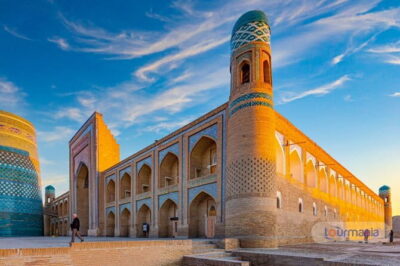
The first major stop is Muhammad Amin Khan Madrasah, described as the largest madrasah in the area. Its scale gives you an early sense of Khiva’s former importance as a center of learning, religion, and government.
A madrasah was not simply a decorative religious school. It was part of the intellectual and social structure of the city. A guide can help you understand how these institutions fit into daily life, rather than leaving you with only an impressive facade.
Nearby, Kalta Minor provides one of Khiva’s most recognizable views. The minaret is short and unusually broad compared with the tall, narrow towers you may expect. Its unfinished appearance is part of its character, and it works as an immediate visual marker for the old city.
The tour does not include going upstairs into minarets. That matters if your main goal is a rooftop or tower view. The itinerary does include a panoramic view tower at Kunya Ark, so you still have a chance for a broader look over Khiva, but you should not assume every tower climb is part of the experience.
Kunya Ark, where the khans ruled
Kunya Ark is the old citadel, and it is one of the most useful stops for understanding Khiva as a seat of power. The complex includes a panoramic view tower, a coinage yard, and summer and winter reception areas.
Those details help you picture the citadel as a working compound rather than a single palace. Coins were produced here, official audiences took place here, and different seasons called for different rooms and arrangements. A good guide can connect the architecture to the practical business of ruling.
The panoramic tower is a major reason to pay attention here. Khiva is compact, so a high viewpoint helps you read the city’s layout. You can better understand how walls, minarets, domes, and palace roofs fit together.
The main limitation is that access to the tower and other structures can depend on separate entrance arrangements. The tour fee does not cover admission tickets to the specified sights. Keep cash or a payment option ready, and ask your guide at the start how the tickets will be handled and what the total cost is likely to be.
A completely different sort of day around Khiva:
- Ayazkala, Toprakkala & Kizilkala Fortress Tour From Khiva
★ 4.3 · 33 reviews - Khiva Historical City Highlights Guided Walking Tour
★ 5.0 · 30 reviews - Aral Sea Adventures (2 day)
★ 5.0 · 30 reviews - Master Class – Shivit Osh Traditional Food Of Khiva
★ 4.2 · 27 reviews
Muhammad Rahimkhan II Madrasah and Djuma Mosque
The route continues to Muhammad Rahimkhan II Madrasah, another reminder that Khiva was shaped by education as well as royal authority. Seeing more than one madrasah can make the city feel repetitive if you only count facades, but the buildings represent different periods and patrons. Your guide’s explanation is especially useful here.
Djuma Mosque offers a change in scale and mood. Rather than focusing on a huge open courtyard or an elaborate exterior, it is known for its forest of more than 120 carved columns.
This is one of the tour’s most distinctive interiors. The columns create a steady rhythm as you look across the prayer hall, and the repeated woodwork gives the space a quieter feel than Khiva’s brightly tiled monuments. Take your time looking upward and along the rows. The details are easy to miss if you rush through with the group.
For me, this stop gives the itinerary balance. The royal citadel explains power, while Djuma Mosque shows how architecture can create atmosphere through shade, repetition, and craftsmanship.
Tosh Hovli Palace and its royal rooms
Tosh Hovli Palace is the second khan’s residence on the route. The name is associated with a stone courtyard, and the complex includes a harem, summer and winter reception areas, a secret corridor, and a special reception room.
This is where the tour moves into the private and ceremonial side of palace life. The harem is not just a sensational label. It formed part of the palace’s residential organization, and its courtyards and rooms help you think about privacy, hierarchy, and the separation of daily life from public audiences.
The secret corridor is the sort of feature that makes a palace visit memorable. It gives the building a practical, slightly mysterious quality. Meanwhile, the summer and winter rooms show how rulers adapted their residences to the climate.
One unusual detail connected with the palace is a gift carriage associated with Tsar Alexander III. That object links Khiva’s local court culture to the wider political world beyond Central Asia. It also gives your guide a natural opening to explain the diplomatic relationships surrounding the khanate.
Tosh Hovli can easily become one of the longer stops because there is so much to take in. If you enjoy decorative tile and palace layouts, you will want time here. If you prefer a fast-moving walk, you may find the number of rooms and courtyards a little demanding.
Kutlug Murad and Allakulikhan Madrasahs
Kutlug Murad Madrasah adds an unexpected turn: it houses a museum of surrealist paintings. This is a welcome break from the steady procession of historic religious and royal buildings.
The pairing is intriguing because the setting and the art belong to very different visual worlds. You move through an old madrasah and then encounter modern, imaginative works that may not fit your expectations of Khiva. That contrast helps keep the tour from feeling like a single repeated lesson in blue tile.
Allakulikhan Madrasah continues the architectural story. At this point, the guide’s commentary becomes important. Without context, several madrasahs can blur together. With clear explanations, you can notice differences in use, design, patronage, and place within the old city.
This is also a good moment to ask questions. The tour is guided in English, and the strongest part of the experience appears to be the personal explanation. Farhod has been praised for explaining Khiva especially well, while another guide received praise for being kind, attentive, and invested in making the visit worthwhile.
The eastern gates and Said Niyaz Mosque
The eastern gates mark another side of the old city and provide a useful sense of Khiva’s defensive and civic layout. The route also includes Said Niyaz Mosque and Madrasah.
These smaller or less famous stops matter because they widen your view beyond the headline monuments. Khiva is not only Kalta Minor and the khan’s palaces. Its identity also comes from the network of places used for prayer, teaching, and local life.
I would pay attention to how the guide describes the relationship between the gate, mosque, and madrasah. The value here is less about one spectacular object and more about seeing how the city’s institutions were placed beside one another.
Islamkhodja Complex and Khiva’s tallest minaret
The Islamkhodja Complex is presented as a symbol of Khiva. It includes a madrasah with a museum of applied art, the Islamkhodja Minaret, and the Islamkhodja School.
The minaret is described as the tallest in the region, making it one of the key skyline features of the tour. Even if you do not climb it, its height helps you understand how religious buildings also shaped the city’s visual identity.
The museum of applied art adds a more hands-on side to the visit. Instead of looking only at buildings, you can connect local design traditions with objects and workmanship.
The Islamkhodja School is especially interesting because it was the first modern and secular school in Khiva. That single fact adds a new chapter to the city’s story. The tour is not frozen in medieval or khanate-era Khiva. It also points toward educational and social change.
Again, admission is extra, and climbing minarets is not included. If the tower is a priority, ask what is currently open before you arrive. The tour gives you the complex, but it does not promise access to every upper level.
Pahlavan Makhmud, the final major stop
The Pahlavan Makhmud Complex is described as the cherry in the cake of the visit, and it is a fitting final stop. This mausoleum honors Pahlavan Makhmud, a revered saint, poet, philosopher, and wrestler according to the cultural tradition connected with the site.
The complex brings together the spiritual and artistic sides of Khiva. After the palaces and administrative spaces, a mausoleum offers a more reflective ending. Pay attention to the tilework, the atmosphere, and the way the building is approached.
It is also a useful reminder that Khiva was not only a royal city. Saints, scholars, artists, worshippers, students, craftsmen, and families all formed part of its life. Ending here gives the route a human focus.
Because it is a major highlight, the stop may be busy or emotionally weighty. Give yourself a few quiet minutes if the guide allows. You do not need to rush every photograph.
The clay oven moment
At some point along the way, you may see local bread being prepared in a clay oven. This is not guaranteed, and it depends on luck, but it could be one of the most memorable details of the afternoon.
That small encounter matters because it connects the monumental city to ordinary work and food. The mosques and palaces tell you about power and belief. Bread-making shows the living culture continuing around them.
Do not judge the tour by whether this moment happens. It is a pleasant bonus, not a promised feature. If you do see it, watch respectfully and let the guide explain what is taking place.
What the $45 price really covers
At $45 per person, the main purchase is the English-speaking guide and the structure of the route. You are paying for a clear path through a dense historic center, explanations at more than a dozen important sites, and help making sense of buildings that could otherwise blur together.
The price is reasonable for a half-day private or guided cultural experience if the guide is as warm and clear as the strongest feedback suggests. The personal quality matters here. Several comments praise friendly service, detailed explanations, cultural insight, and help with photography. One guide was specifically appreciated for revealing side stories and details not normally found in standard guidebooks.
But $45 is not the full sightseeing budget. Entrance tickets to all specified objects are excluded, and there are multiple admissions. You should ask about the likely total before starting so the cost does not surprise you.
The tour also does not include personal expenses or access upstairs in minarets. That makes the experience best for someone who wants guided interpretation on the ground, rather than a package that includes every ticket and viewpoint.
Free cancellation up to 24 hours before the tour and the option to reserve without paying immediately add useful flexibility. These policies are practical if your Uzbekistan route is still changing.
Who should book this Khiva walk?
I would choose this tour if you want a strong first introduction to Khiva and prefer a guide to connect the pieces. It suits first-time visitors, culture-focused couples, families with older children, and anyone who wants more than a quick photo circuit.
It is also a good fit if you enjoy architecture but want historical and cultural context. The range is broad: fortifications, palaces, schools, mosques, madrasahs, applied art, a modern painting collection, and a mausoleum.
You may want something different if you dislike walking for several hours, want guaranteed tower access, or need all admissions bundled into one price. The itinerary is full, and the number of historic sites can feel dense. You will get more from it if you are willing to pause, ask questions, and accept that not every stop will receive the same amount of time.
The morning and afternoon departures make it easier to fit into a Khiva schedule. English is the stated tour language, so confirm that this matches your needs before booking. The listed rating of 4.8 from 17 bookings supports the idea that guide quality is a major strength, particularly in friendliness and storytelling.
Should you book the Khiva Guaranteed Tour?
Book it if you want Khiva explained, not merely photographed. The route covers the city’s main architectural landmarks and adds unusual details such as the surrealist painting museum, the first secular school, the secret palace corridor, and the chance of seeing clay-oven bread prepared.
Before paying, plan for separate entrance fees and do not expect to climb the minarets as part of the $45. With those limits understood, this is a well-shaped half-day introduction to one of Central Asia’s most distinctive historic cities. I would especially recommend it for your first day in Khiva, when a friendly guide can help you get oriented and decide which places deserve a slower return visit.
FAQ
Where does the Khiva tour begin?
The meeting point is the ticket office at Ata Darvaza, the western gate of the city.
What time does the tour start?
The listed start times are 09:00 and 15:00. Availability should be checked when booking.
How long does the tour last?
The tour lasts about 4.5 hours, with the stated duration also given as four to five hours.
Are entrance tickets included?
No. Entrance tickets to the specified attractions are not included, and there may be multiple separate admissions.
Can I climb the minarets during the tour?
Going upstairs to the minarets is not included.
What language is the tour offered in?
The tour is offered with a live English-speaking guide.
Recently added around Khiva
- A Night In The Kyzylkum Desert [2] From Khiva★ 4.5 · 3 reviews
- Khorezm Fortress and KyzylKum Desert Private Tour★ 5.0 · 3 reviews
- Best of Khiva: Exclusive Private Tour!★ 5.0 · 3 reviews
- Khiva: City Highlights Guided Walking Tour★ 4.6 · 3 reviews
- Khiva: classic Half-Day Tour★ 3.7 · 3 reviews
- Master Class – Uzbek Bread (Khiva)★ 3.5 · 4 reviews
- Uzbekistan 6 Days Private Tour Khiva-Bukhara-Samarkand by Train★ 5.0 · 4 reviews
- Traditional Khiva Cooking Class with Market Visit & Lunch★ 5.0 · 4 reviews
Khiva Tours, compared.
Khiva Historical City Highlights Guided Walking Tour
Read our review →Master Class – Shivit Osh Traditional Food Of Khiva
Read our review →
Browse the lists this tour appears in