
Reviewed · WALKING TOURS
Bukhara Walking Tour
Bukhara reveals its best stories on foot. This $28 private walking tour links the city’s major Islamic monuments, old trading domes, Jewish quarter, Ark Citadel, and early mausoleums in about five to six hours. I like the broad route and the chance to see both famous sights and smaller cultural stops, especially the puppet theater and carpet museum. The main drawback is that monument entrance fees and lunch are extra, so the final cost will be higher than the headline price.
The tour begins at Lyabi Hauz and finishes at the Samanid Mausoleum, creating a useful west-to-east walk through Bukhara. Guides speak English, Spanish, French, German, or Russian, and the strongest praise goes to patient, flexible guides such as Peri and Nilufar, whose clear English and command of local history helped make the long route manageable.
In This Review
- Key points before you book
- Why this walking route works in Bukhara
- Starting beside the water at Lyabi Hauz
- A short look at Central Asian puppet theater
- Magoki Attori Mosque and the carpet museum
- Two madrasas from different eras
- The dramatic heart of the route at Poi Kalyan
- Entering the Ark, the emir’s winter residence
- Bolo Hauz and the reflected columns
- Chashmai Ayub and Bukhara’s water supply
- Finishing at the Samanid Mausoleum
- What the $28 price really covers
- Guides, languages, and the pace of the day
- Small practical details that affect your choice
- Who should book this Bukhara walk?
- Should you book the Bukhara Walking Tour?
- FAQ
- How long does the Bukhara Walking Tour last?
- Where does the tour begin?
- Where does the tour end?
- Is this a private tour?
- Are monument entrance tickets included?
- Is lunch included?
- What languages are available for the guide?
Key points before you book
- A private five to six-hour route covers Bukhara’s essential monuments, with only your own group taking part.
- The tour begins at Lyabi Hauz and ends at the Samanid Mausoleum, so you do not return to the starting point.
- The schedule mixes grand landmarks with smaller cultural stops, including puppet theater, carpets, and a historic bathhouse reception.
- Entrance tickets are not included, even though the tour includes a professional guide and all listed taxes and fees.
- The strongest guide praise centers on patience, flexibility, energy, and excellent English, especially from guides named Peri and Nilufar.
- The route is best for first-time visitors with one full sightseeing day, but less suited to anyone wanting a slow, unhurried look at every monument.
Why this walking route works in Bukhara
Bukhara is unusually well suited to a guided walking day. Many of its major sights sit within the old central area, and the sequence here gives you a clear sense of how religious schools, mosques, markets, royal power, and water shaped the city.
You are not simply moving from one photo stop to another. The route begins beside a reservoir, passes old madrasas and trading domes, reaches the great Poi Kalyan complex, then shifts toward the Ark and the city’s older mausoleums. That order helps you see Bukhara as a working city rather than a collection of isolated monuments.
The private format is a real advantage. Your group can ask questions without competing with a busload of people, and the guide can adjust explanations to your interests. The feedback about Peri and Nilufar points to exactly the sort of service that matters here: patience, flexibility, strong English, and the ability to explain many sites without making the walk feel like a memorized speech.
The five to six-hour length is both a strength and a warning. You see a lot, but this is not a casual stroll with long café breaks. The listed stop times add up to roughly five hours before walking between sites, questions, ticket purchases, and pauses. I would treat the advertised duration as a realistic half-day commitment.
More Walking Tours in Bukhara
- Bukhara: Walking Tour with a Small Group
★ 4.9 · 260 reviews - All You Need To Know About Bukhara. A Walk In The Town
★ 4.9 · 31 reviews - Bukhara Walking Tour
★ 4.7 · 25 reviews
Starting beside the water at Lyabi Hauz
The tour opens at Lyab-i-Hauz, Bukhara’s social center and one of the most atmospheric places to begin. The name refers to the pool, around which the complex developed. The area becomes especially active in the evening, but during the tour it provides an immediate introduction to Bukhara’s public life.
Your guide explains three important buildings here:
- Kukeldash Madrasah
- Nadir Divanbegi Madrasah
- The Nadir Divanbegi Khanaka, a lodging place for dervishes
Allow about an hour at this first stop. That is useful because the complex gives you several architectural subjects at once, rather than a single facade and a quick photograph.
The khanaka adds an important human detail. Madrasas were centers of religious learning, while a khanaka served dervishes. Seeing them together helps you understand that Bukhara’s religious quarter supported teaching, worship, study, and residence.
Admission is not included, so ask your guide early which buildings you will enter and which you will view from outside. The tour information lists admission as separate at every stop, and costs can add up when a route includes this many monuments.
A short look at Central Asian puppet theater
The puppet theater stop lasts about 20 minutes and offers a change of pace from stone, brick, and tile. It is described as the only place in Uzbekistan where you can learn about Central Asian puppets and puppet theater.
You may also see a two-minute demonstration by the master himself. If luck is on your side, puppets may be available to view or purchase. The wording matters here: the performance and purchase opportunity are not guaranteed, so treat them as a welcome bonus rather than the main reason to book.
I like this stop because it gives the walking day a cultural texture that monuments alone cannot provide. It also creates a natural pause before the religious architecture resumes. If you have children in your group, this may be one of the easiest parts of the route for them to enjoy.
Magoki Attori Mosque and the carpet museum
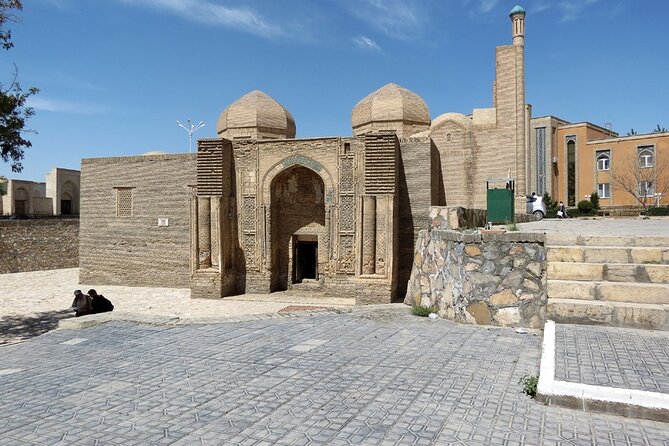
Next comes Magoki Attori Mosque, described as the first mosque in both Bukhara and Uzbekistan. The building is also identified as a pre-Mongol monument, which places it among the city’s oldest surviving Islamic sites.
The site carries an unusual earlier connection. Before Islam, the location was used by pagans selling idols. That detail gives your guide a chance to explain how sacred and commercial spaces changed over time, rather than presenting the mosque as a building with only one historical chapter.
A carpet museum is included with this stop. The tour allows about 15 minutes, which is enough for an introduction but not a long museum visit. If carpets interest you, ask focused questions and keep an eye on the clock, since the route has several major sites still ahead.
This is one of the places where a good guide makes a large difference. The building’s age and layered use can be hard to understand from architecture alone. A clear explanation turns a short stop into a useful piece of Bukhara’s story.
A completely different sort of day around Bukhara:
- Best of Bukhara: All Day Private Old Town Tour
★ 5.0 · 66 reviews - Best of Bukhara: All Day Private Old Town Tour
★ 4.9 · 62 reviews - From Bukhara: 2-Day Desert Yurt Camp Tour
★ 4.5 · 57 reviews - City Tour Around Bukhara
★ 5.0 · 55 reviews
Two madrasas from different eras
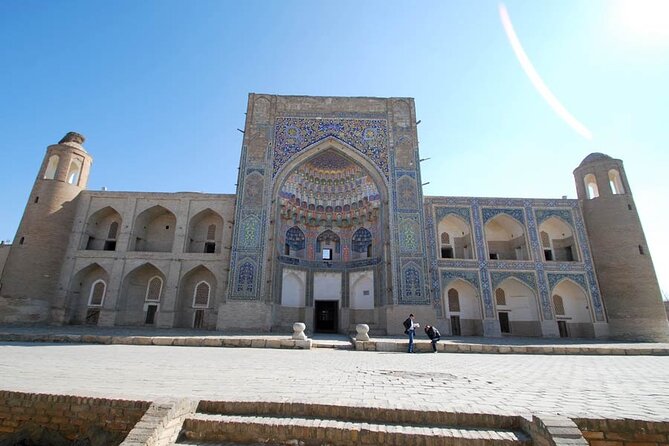
The Ulugbek Madrasah receives about 15 minutes. It is described as the oldest madrasa in Bukhara and the only monument in the city from the Timurid period.
Ulugbek was a ruler and patron of learning, so this stop helps connect Bukhara with the wider Central Asian world of scholarship and imperial building. The short visit works best as an architectural and historical introduction. You should not expect an extended exploration of every room.
The Abdulaziz-Khan Madrasah follows, also for about 15 minutes. It is presented as Bukhara’s most magnificent madrasa and the first monument in the city to use yellow coloring.
These two stops work well together. Ulugbek Madrasah represents an earlier Timurid phase, while Abdulaziz-Khan introduces a later and more decorative style. Your guide can point out the contrast in ornament and color, making the pair more meaningful than either building would be on its own.
The limitation is time. Fifteen minutes per madrasa is brisk, particularly if you want interior photographs or detailed architectural explanations. I would use these stops to decide which sites deserve a return visit later in your stay.
The dramatic heart of the route at Poi Kalyan
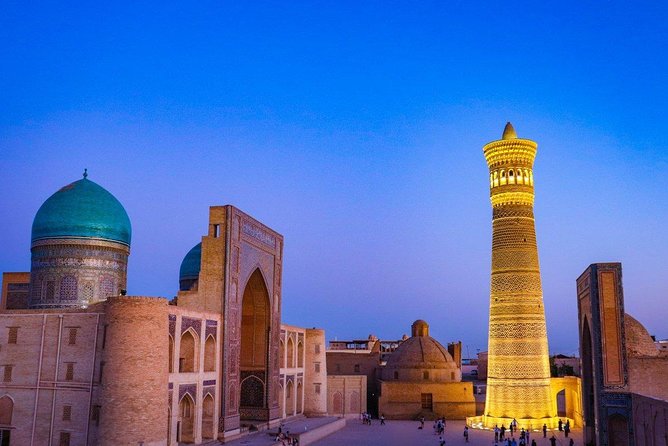
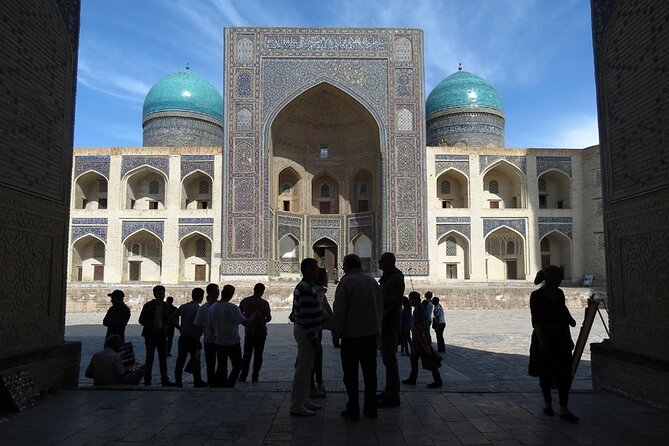
The tour spends about an hour at Poi Kalyan, the largest single block of sightseeing on the route. The complex contains three monuments:
- Kalyan Minaret
- Kalyan Mosque
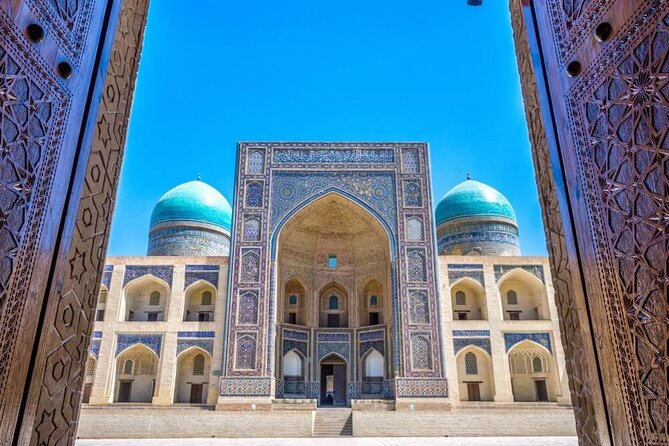
- Miri Arab Madrasah
The Kalyan Minaret is the tallest minaret in Bukhara and one of the city’s three pre-Mongol monuments. Its survival gives the site unusual weight, especially when your guide sets it beside the later buildings around it.
Kalyan Mosque is described as the largest medieval mosque in the city. The scale of the complex is the main point here. You need time to look across the open space, study the relationship between the minaret and mosque, and listen to the explanation of how the buildings functioned together.
Miri Arab Madrasah remains a working madrasa for male students. That fact gives the square a living purpose. This is not only a preserved monument for sightseeing. It is also a place connected with religious education today.
Admission is separate, and the tour data does not state which parts of the complex are open at the time of your visit. Ask your guide what you can enter before buying tickets. The hour allocated here is sensible, but anyone who enjoys photography may want more time.
Poi Kalyan is likely to be the visual high point of the day. Still, I would not rush the earlier sites just to reach it. Bukhara’s appeal comes from the contrast between major squares and smaller, less obvious buildings.
Entering the Ark, the emir’s winter residence
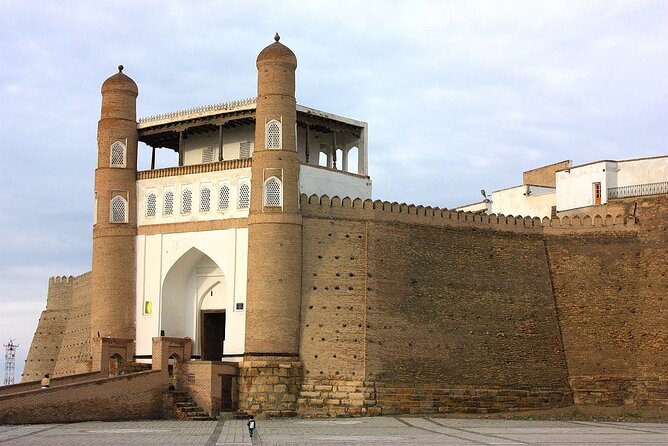
The Ark Citadel receives about 40 minutes. It was the winter residence of the Bukhara emirs and was regarded as a city within the city.
That description gives you the right way to approach it. The Ark was not simply a fortified palace. It contained a separate royal world, with its own authority and functions. A guide can help you make sense of that scale and explain how the citadel fit into Bukhara’s political life.
Forty minutes is enough for an overview of the site, but the visit may feel short if several interior areas are open. Since entrance tickets are not included, confirm what your ticket covers and how much time you will have inside.
The Ark also provides a useful change after the religious architecture of Poi Kalyan. You move from learning and worship to royal power, which keeps the route from becoming a long string of similar madrasas.
Bolo Hauz and the reflected columns
Bolo Hauz Mosque is a 20-minute stop. It is known for having the city’s highest columns and is also called Chilustun, meaning 40 columns.
The mosque itself has 20 columns, but their reflections in the reservoir create the impression of 40. This is the kind of small visual fact that makes a short stop memorable. Look toward the water rather than only at the building.
The stop fits naturally with the route’s opening at Lyabi Hauz. Both places show how water shaped the city’s public and religious spaces, though the tour does not begin and end at the same reservoir.
Twenty minutes should be enough for an explanation and photographs. If you enjoy architectural details, use the time to examine the columns and their reflection before moving on.
Chashmai Ayub and Bukhara’s water supply
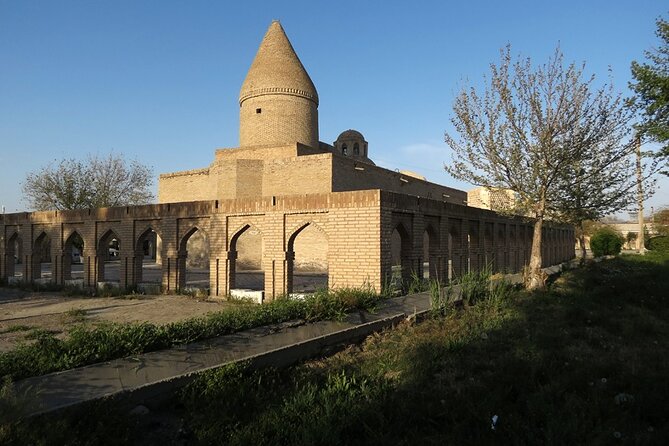
The Chashmai Ayub Mausoleum receives another 20 minutes. It serves as the city’s water supply museum and is also identified as the mausoleum of Ayub, or Saint Jehovah in the supplied description.
This stop adds practical history to the tour. Water is easy to take for granted, but in an old Central Asian city it was central to survival, settlement, religion, and public life. A water museum offers a useful counterpoint to grand monuments because it focuses on an everyday need.
The mausoleum’s religious association gives the building a second layer. You can ask the guide to clarify the connection between the sacred site and the museum collection, since the tour description presents both roles together.
As with the other monuments, admission is not part of the $28 price. The short time allocation makes this more of an introduction than a full museum visit.
Finishing at the Samanid Mausoleum
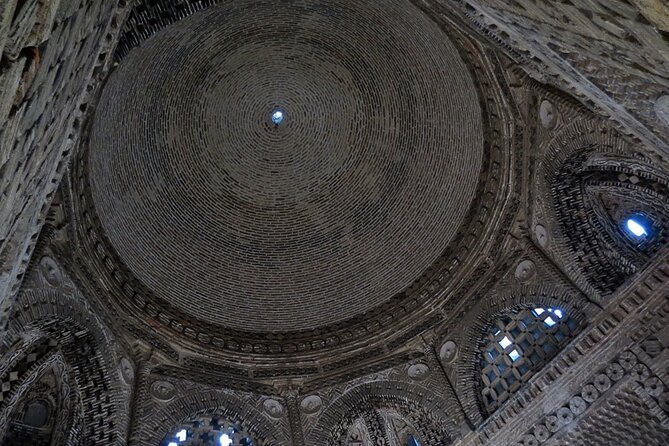
The final stop is the Ismail Samani Mausoleum, with about 30 minutes scheduled. The tour ends here, so plan your onward arrangements from this location rather than from Lyabi Hauz.
The mausoleum is described as the first in Central Asia and the second in the Islamic world. It is also linked to the founder of the first local empire in Central Asia. Those claims make this one of the most important historical stops on the route.
Ending here is a good design choice. After seeing mosques, madrasas, markets, a citadel, and a water museum, you finish with an early funerary monument that brings the city’s long timeline into focus.
Thirty minutes allows a proper explanation and time to look around, though it may not be enough if you want to linger. Since there is no return transport included, check your map before the tour ends and note that the meeting point and final stop are different.
What the $28 price really covers
At $28, the tour offers good value if you want a guide to organize a large amount of sightseeing in one private outing. The cost includes a professional guide and all fees and taxes listed by the operator. It does not include monument admission, lunch, transport, or personal expenses.
The absence of transport is not a serious weakness for this particular experience. It is sold as a walking tour, and the route is designed around Bukhara’s central sights. You should still be comfortable walking for several hours and moving between stops at a steady pace.
The bigger budget question is admission. Because every listed stop says tickets are not included, you should set aside extra money for the monuments you choose to enter. The guide can help you decide where entry adds the most value, especially if you prefer not to pay for every interior.
Group discounts are available, and the activity is private, meaning only your own group participates. The listing does not state the exact discount structure, so ask about the price for your party before booking.
Guides, languages, and the pace of the day
The guide is the main reason to choose this tour instead of walking the same route alone. Bukhara’s buildings are striking, but dates, rulers, religious uses, and architectural terms can blur together without explanation.
The best feedback highlights Peri’s patience and detailed explanations. Nilufar is praised for punctuality, energy, encyclopedic knowledge of her hometown, and excellent English. Another assessment emphasizes a kind, flexible guide who remained patient throughout the walk.
Those details matter more than a list of language options. A guide who can adjust the pace and answer questions will make the five to six hours much more useful. English, Spanish, French, German, and Russian are listed as available languages, but you should confirm your preferred language at booking.
The route suits most participants, according to the provided tour information. Still, the length and number of stops mean you should think honestly about your walking comfort. Anyone seeking a slow architectural study may find the schedule too tight, while first-time visitors with limited time will appreciate the coverage.
Small practical details that affect your choice
The meeting point is the Lyabi Khause ensemble, specifically near the Divan-Beghi area in Bukhara. The tour finishes at the Ismail Samani Mausoleum, not at the starting point.
Mobile tickets are supported, and confirmation is provided at booking. Free cancellation is available if you cancel at least 24 hours before the start time. Cancellations within 24 hours are not refunded, and changes in that final 24-hour period are not accepted.
The tour has a rating of 4.8 from four published ratings. That is encouraging, especially because the praise is consistent about guide quality, but the sample is small. I would use the feedback as a positive sign, not as proof that every departure will be identical.
Who should book this Bukhara walk?
I would recommend it to a first-time visitor who wants to see Bukhara’s major sights in one organized day. It is also a good fit if you have only one full day in the city, want explanations in your own language, or prefer a private tour over a large group.
It suits couples, families, and small parties that value flexibility. The puppet theater and reflected columns at Bolo Hauz add variety for younger members of a group, while the madrasas, mosque complex, and mausoleums give serious history fans plenty to study.
I would hesitate if you want a slow day with long meals, extensive museum time, or repeated visits to the same monument. The route is broad by design. You see many places, but most stops are introductions rather than exhaustive visits.
Should you book the Bukhara Walking Tour?
Book it if you want strong coverage and a private guide for $28 before admission costs. The route includes nearly every major Bukhara sight listed in the program, and the best guide feedback points to patient explanations, flexibility, energy, and excellent English.
Before paying, confirm the language, the expected monument ticket costs, and how your group will get onward from the Samanid Mausoleum. If you accept the brisk pace and extra admission charges, this is a practical way to get your bearings and understand why Bukhara is called a pillar of Islamic culture.
FAQ
How long does the Bukhara Walking Tour last?
The tour lasts approximately five to six hours. The scheduled visits include Lyab-i-Hauz, the puppet theater, Magoki Attori Mosque, two madrasas, Poi Kalyan, the Ark, Bolo Hauz Mosque, Chashmai Ayub Mausoleum, and the Samanid Mausoleum.
Where does the tour begin?
It begins at the Lyabi Khause ensemble near Divan-Beghi in Bukhara, Uzbekistan.
Where does the tour end?
The tour ends at the Ismail Samani Mausoleum. It does not finish at the Lyabi Khause meeting point.
Is this a private tour?
Yes. Only your own group participates in the activity.
Are monument entrance tickets included?
No. Entrance to the monuments listed in the program is not included in the tour price.
Is lunch included?
No. Lunch and personal expenses are not included.
What languages are available for the guide?
Professional guides are listed as available in English, Spanish, French, German, and Russian.
Recently added around Bukhara
- Uzbekistan 8 Days Private Guided Tour★ 4.6 · 3 reviews
- Bukhara: City Highlights Guided Tour with Pickup★ 5.0 · 3 reviews
- 9 Days Private Guided Tour to Uzbekistan★ 5.0 · 3 reviews
- Full-Day Private Guided Tour to Islamic 7 Saints of Bukhara★ 4.5 · 3 reviews
- 2 Day Ukhum Hiking Tour from Bukhara★ 5.0 · 4 reviews
- Bukhara in a Day History, Culture, and Local Insight Private Tour★ 5.0 · 4 reviews
- Legends of Bukhara: Exclusive Full-Day Tour★ 5.0 · 4 reviews
- Bukhara: Full-Day Guided Tour with English-Speaking Guide★ 5.0 · 4 reviews
Walking Tours, compared.
Samarkand One Day Tour: one day walking & group tour
Read our review →Browse the lists this tour appears in